This is the fourth homework assignment for Lasers and Optomechanics at Syracuse University.
It is due Monday, April 6th, 2026 by 5 pm
You will need to complete the questions in this jupyter notebook and submit it via gitlab
1Transmitted Field Dither Locking
In class, we investigated dither locking using the reflected field from a Fabry-Perot cavity.
In this problem, investigate whether it is possible to use to hold lock.
1.1Plot of Fabry-Perot versus 
Plot both and over a span of
Do you notice anything different about the resonance points?
1.2Total with end-mirror moduation
If we apply an end-mirror modulation to our Fabry-Perot cavity, what is the total field?
1.3Calculate the total transmitted power 
Calculate
You may set for simplicity in the calculations.
You should end up with only DC and 1 terms.
You may leave this power term in a general form if you wish, but you must be clear what each of the contributing fields are.
1.4Calculate the transmitted power demodulated at 
Calculate the demodulated term . This should be directly proportional to .
1.5Plot the length to transmitted power function phase sweep
Plot the real and imaginary parts of over
Choosing some low to moderate finesse cavity parameters, plot your derived function as a function of carrier phase .
Let the cavity parameters be
1.6Plot the length to transmitted power transfer function
Plot your transfer function magnitude and phase as a function of frequency .
Use the same cavity parameters as above, but allow , while setting .
2Pound-Drever-Hall Michelson
In-class we went over the Pound-Drever-Hall (PDH) Fabry-Perot interferometer.
Now we’ll try to apply the same technique lock a Michelson interferometer to it’s carrier dark fringe.
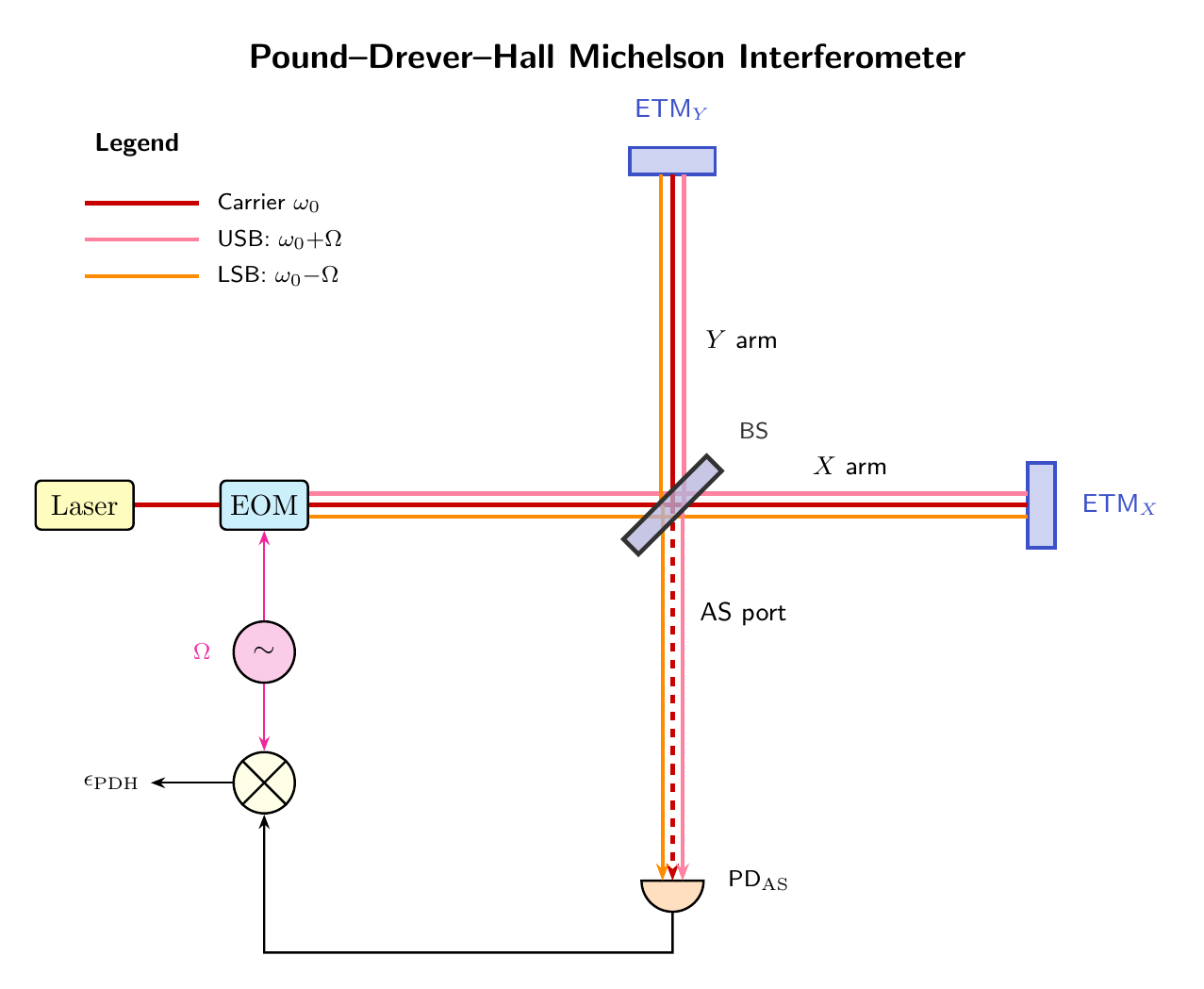
Below is a diagram of a Michelson with carrier at ,
and two RF phase sidebands created by an electro-optic modulator (EOM)
oscillating at to create two frequencies .
Our goal is to calculate the PDH error signal as a function of the carrier phase offset and RF sideband frequency .
2.1Calculate the total dark field .
Calculate the full field expression at the dark port of the interferometer.
There should be three contributions, one from carrier and two from the RF phase sidebands injected alongside the carrier.
Let the modulation depth of the RF sideband be .
Let the carrier differential phase be ,
and the RF phase differential phase be .\
What happens to our phases and if exactly?
Hint: The RF sidebands will experience a phase shift of as it transmitted through the interferometer
2.2Calculate the total dark power .
Calculate .
Assume that the second order modulation terms , for simplicity.
2.3Calculate the dark power demodulated at 
Calculate and plot the phase sweep of for . for some assumed cavity parameters:
What do you notice about this signal as we increase the offset ?
3Fabry-Perot Michelson Interferometer (FPMI)
We investigated compound interferometers in class when we studied the coupled-cavity.
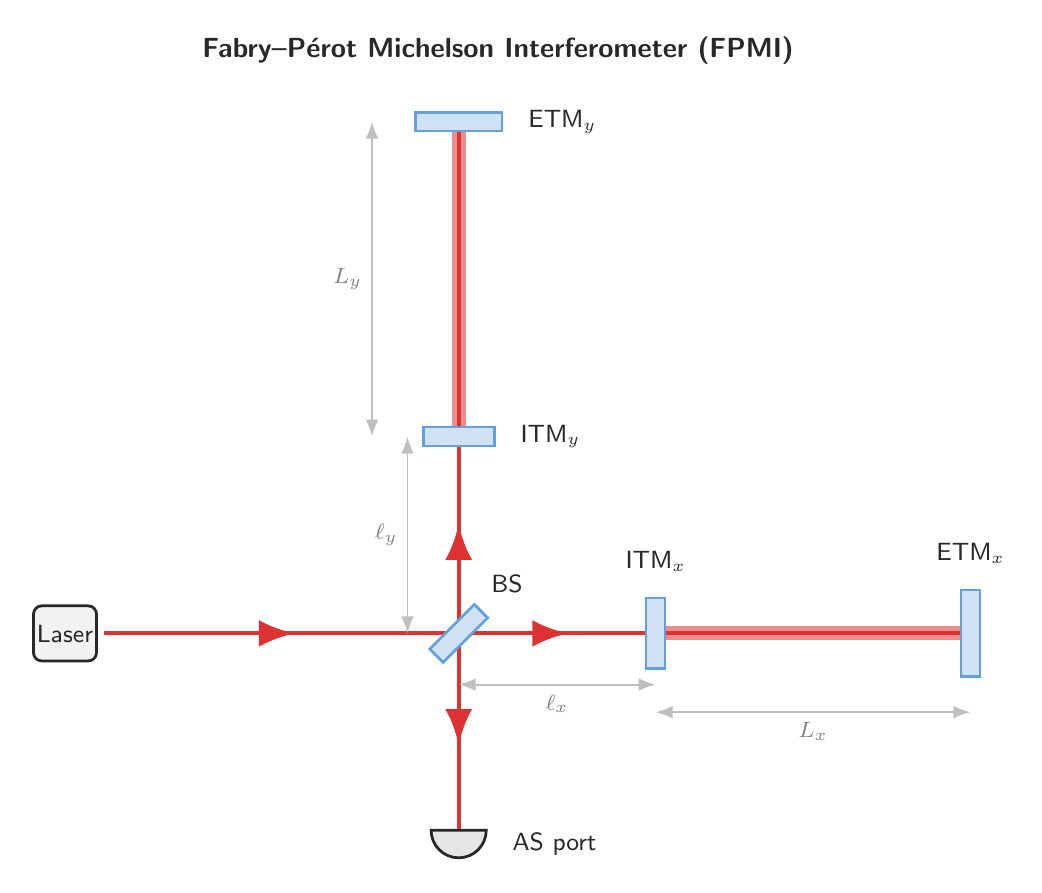
Here we combine our Michelson interferometer with Fabry-Perot interferometers forming the arms,
forming the Fabry-Perot Michelson Interferometer (FPMI) in a configuration similar to LIGO.
3.1Adjacency Matrix
Form an adjacency matrix for the FPMI interferometer.
I recommend using and for the short Michelson arms,
and and for the Fabry-Perot arm lengths.
3.2Antisymmetric Port Field Derivations
Find the transfer function by inverting the adjacency matrix.
You may also derive the FPMI response by using the compound interferometer technique,
by letting the common Michelson X-arm reflection .
Does this derivation agree with your result from the adjacency matrix?
3.3Simplifications to 
At this point, you may simplify and change the basis using
The above assumes the short Michelson is always perfectly tuned, and the beamsplitter is ideal, and the Fabry-Perot arms are ideally balanced.
3.4Interpretation
Plot the real and imaginary parts of as a function of .
Compare to the normal Michelson solution for the AS port.
Do the Fabry-Perot arms enhance our sensitivity to differential displacement ?
You may substitute in a moderate finesse Fabry-Perot cavity values