A Michelson interferometer holds a special place in history.
The its inventors, Michelson and Morley, used the interferometer to disprove the existance of a dispersive ether modulating light in our universe.
Now, we use the Michelson interferometer as the fundamental building block of modern gravitational wave detectors.
Today, we will overview the basics of the Michelson.
Source
%matplotlib widget
import numpy as np
import matplotlib as mpl
import matplotlib.pyplot as plt
from ipywidgets import *

plt.style.use('dark_background')

fontsize = 14
mpl.rcParams.update(
    {
        "text.usetex": False,
        "figure.figsize": (9, 6),
        # "figure.autolayout": True,
        # "font.family": "serif",
        # "font.serif": "georgia",
        # 'mathtext.fontset': 'cm',
        "lines.linewidth": 1.5,
        "font.size": fontsize,
        "xtick.labelsize": fontsize,
        "ytick.labelsize": fontsize,
        "legend.fancybox": True,
        "legend.fontsize": fontsize,
        "legend.framealpha": 0.7,
        "legend.handletextpad": 0.5,
        "legend.labelspacing": 0.2,
        "legend.loc": "best",
        "axes.edgecolor": "#b0b0b0",
        "grid.color": "#707070",  # grid color"
        "xtick.color": "#b0b0b0",
        "ytick.color": "#b0b0b0",
        "savefig.dpi": 80,
        "pdf.compression": 9,
    }
)1Michelson Topology
A Michelson interferometer is the second least-complicated non-trivial interferometer behind the Fabry-Perot.
It does not have any recycling elements, i.e. no electric fields feed back to themselves, there are no loops in the graph.
A Michelson consists of a beamsplitter, typically 50:50, and two mirrors with reflectivity and which reflect the laser back to the beamsplitter.
The space between mirror and beamsplitter are called arms.
The Michelson uses the same light source for both arms.
This is crucial to ensuring the the light is coherent and split evenly in both arms of the interferometer.
The Michelson also exhibits great common mode rejection: when the interferometer is held at it’s dark fringe, where no light is transmitted, anything that happens to the source light will occur the same in both arms, and will tend to be reflected by the Michelson.
We’ll dive into these technical details below, but for now, we will assert the following:
the Michelson interferometer is an extremely good detector of differential motion: it can isolate differential signals, even in the presence of high common or source noise.
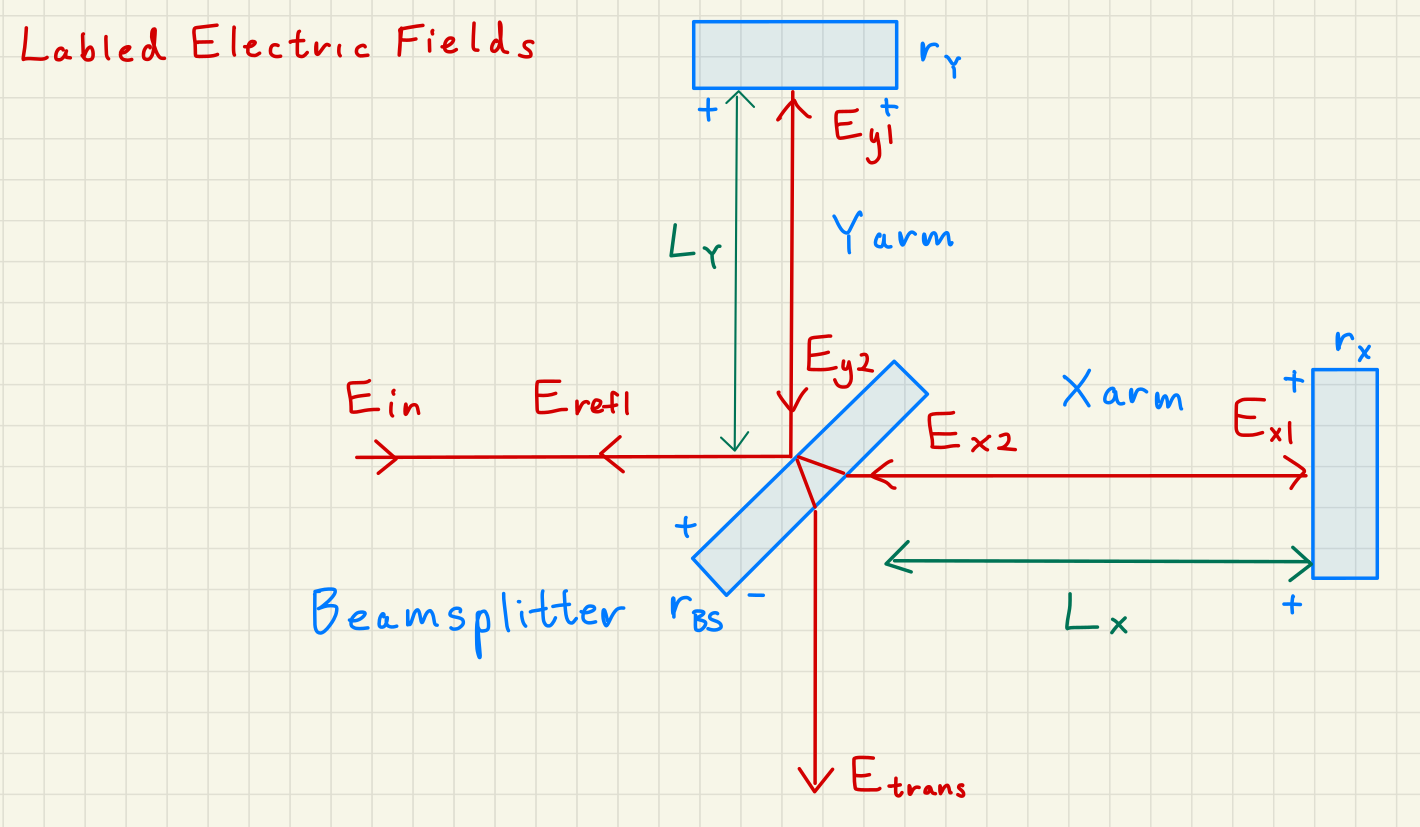
Michelson interferometer topology with electric fields labeled.
2Michelson Field Equations
If we assume plane-wave solutions to the Michelson , and employ our propogating and mirror transition matrices, we can write the following system of equations:
where is the reflected, or symmetric port,
and is the transmitted, or antisymmetric port.
I may switch haphazardly between .
The term antisymmetric refers to how many reflections and transmissions the beam experiences.
The antisymmetric port is also called the dark port, due to the fact the Michelson is often operated with no light at this port.
The symmetric beam receives either two reflections or two transmissions, depending on which arm you focus on.
The antisymmetric beam gets one reflection and transmission, no matter the arm you focus on.
We can use the optical diagram to draw a directed graph of the Michelson below.
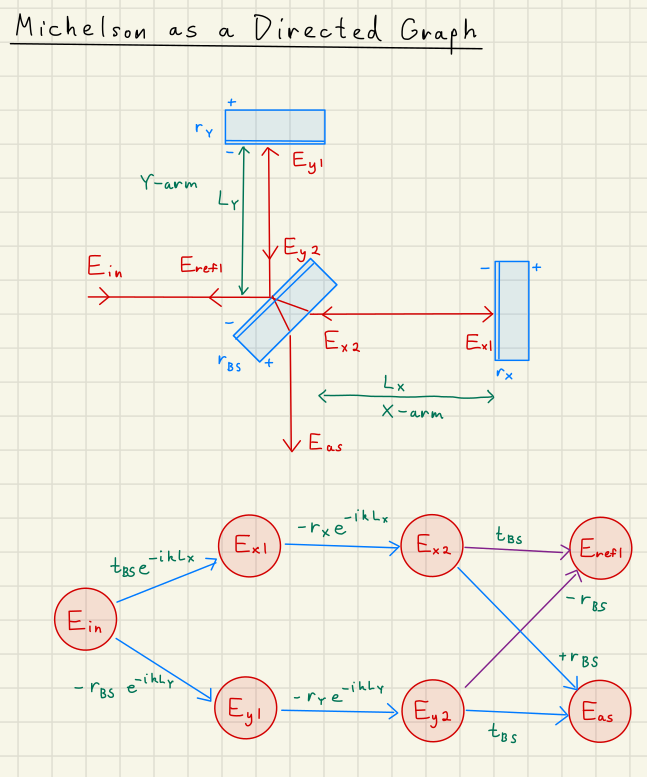
Michelson directed graphs
Solution to Exercise 1 #
First, the electric field state vector is
Then the adjacency matrix becomes:
Inverting the identity matrix minus the adjacency matrix gives us the steady state transfer functions for each of the electric fields:
This matrix contains all the transfer functions from one field to another.
For instance, the transfer function from to will simply be the matrix element in the first column (cooresponding to )
and the sixth row (cooresponding to ), or matrix element :
Similarly:
2.1Solutions to the Michelson Output Fields
From our solutions to either Eq. (1), or from Solution to Exercise 1,
we can solve for the symmetric and antisymmetric output fields and from the only source field :
Let’s stop here to analyze these Equations (7) briefly.
2.2Analysis
There are a couple of key observations we can make about the Michelson output fields.
The main interference in both output fields comes from the difference in the arm lengths and .
This represents a degree of freedom of our optical system, called the differential arm length, or DARM.Sign difference in the interference
If , we get destructive interference at and constructive interference at .
This allows us to conserve power output from the interferometer.Perfect interference relies on matching the reflectivity of the end mirrors , as well as having a ideal beamsplitter .
Imperfect interference will lead to contrast defect, a crucial parameter for interferometers.No matter the field or frequency of the input field, the output fields will be an attenuated copy of the input field.
For a perfect Michelson, common mode rejection tends to reflect any changes in back toward the input port .
This is ideal if we care only about motion of the mirrors from the differential degree of freedom DARM.
2.3Simplifications
For a first analysis, it’s common to assume some basic parameters and make some simplications of the transfer functions in Eq. (7).
represents our single-pass phase of each arm,
represents the lossless, perfect 50:50 beamsplitter, and
represents the matched, perfectly reflecting end mirrors
are the differential phase and common phase .
Note that the differential arm length and phase are related like ,
and inverting the solutions in Eq. (11) yields
Applying the above simplifications to our output transfer function to yields
yields a crucial result
Going through a similar derivation gives
Equations (14) and (15) represent the fields at the outputs of the Michelson.
Both fields are rotated by an arbitrary phasor , which corresponds to the common mode length of the Michelson arms.
Both fields amplitudes are modulated by the differential arm length , 90 degrees out-of-phase with one another.
Finally, both are rotated relative to each other by a factor of , putting them in strictly different quadratures of light.
2.4Quadrature Picture
Writing Eqs. (14) and (15) in the quadrature picture yields
which emphasizes how the common phase rotates which quadrature the light is in,
but has no effect on the amplitude of the light.
The differential phase is the most crucial for determining whether the field is transmitted or not.
The quadrature picture is illustrated in the interactive phasor plot below.
2.5Operating Points
Dark Fringe 
Typically, the differential phase will be the desired operating point.
This represents the dark fringe, the operating point at which the arms are balanced at the microscopic level, i.e. their lengths are precisely the same.
The transmitted field will be zero in this instance, and the entire beam in the interferometer will be reflected at .
Bright Fringe 
On the other hand, it’s also possible to send all of the light to the transmitted field ,
by setting .
This is called the bright fringe, and is useful for maximizing power through the Michelson,
aligning the Michelson mirrors using the fringes, establishing optical output paths, and estimating output losses.
Dark Offset 
Finally, a dark offset is when the Michelson is operated near to a perfect dark fringe, but not directly there: .
This is often done to allow a small amount of electric field to “leak out” of the Michelson transmission,
to allow a strong local oscillator to beat with a weak signal of interest.
This is currently how Advanced LIGO’s DARM degree of freedom is detected, via the DARM offset detection technique,
which allows for exquisite sensitivity to our weak signal of gravitational waves.
2.6Fringe Width
In a real “balanced” Michelson interferometer, the lengths are not exactly the same, so we write
The above relationship defines the fringe width of the Michelson, i.e. the length the mirrors must be moved to cycle from one dark resonance to another.
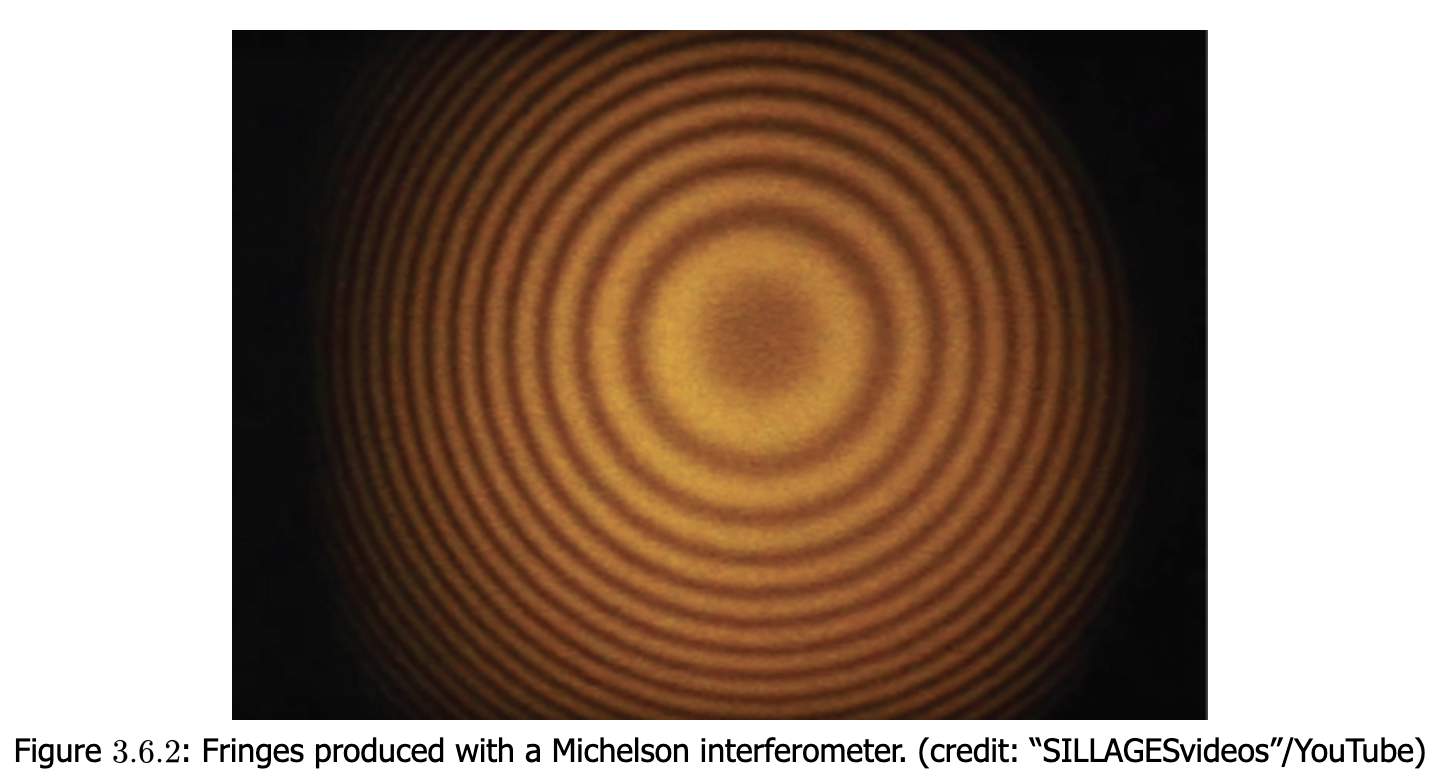
Common Michelson Fringe Pattern
2.7Free Spectral Range
Via similar logic to the fringe width, the Michelson free spectral range, or the frequency spacing between fringes, can be found to be the same as for the Fabry-Perot:
2.8Contrast Defect
Contrast defect defines the light power that transmits through the Michelson even when held on perfect resonance.
This is due to imperfections in the Michelson interference achieved at the antisymmetric port.
Below we examine one such imbalance where the arm reflectivites are different.
Solution to Exercise 2 #
Start with Eq. (7), but set
This will give us, for :
For the last solution of (20), the right-hand-side’s left term is the same as Eq. (14) above.
But the right term depends on the differential reflectivity which is in a different quadrature (rotated by ).
A similar derivation will give :
which also experiences an alteration of the quadrature of light due to differential reflectivity .
This light in the wrong quadrature due to is called contrast defect.
Contrast defect light shows up at the antisymmetric port even when the interferometer is held perfectly on resonance, i.e. .
This limits the achievable level of common-mode rejection in the interferometer.
It also is a cause of noise inside the interferometer, as it tends to mix with weak electric field modulation.
So the contrast defect field carries no useful signal about DARM, but contributes noise to the interferometer.
We work hard to ensure our interferometer arms are well-matched in reflectivity, as well as all aspects, to limit the level of contrast defect.
2.9Michelson Phasors
# Michelson reflection, including contrast defect r_d
def mich_refl(phi_d, phi_c, r_d, r_c):
    deg = np.pi/180
    return -np.exp(1j * deg * phi_c) * (r_c * np.cos(deg * phi_d) - 1j * r_d * np.sin(deg * phi_d))

# Michelson transmission, including contrast defect r_d
def mich_trans(phi_d, phi_c, r_d, r_c):
    deg = np.pi/180
    return -np.exp(1j * deg * phi_c) * (-1j * r_c * np.sin(deg * phi_d) + r_d * np.cos(deg * phi_d))
phi_d = 0
phi_c = 0
r_d = -0.05
r_c = 0.9Source
fig, ax1 = plt.subplots(1)

phi_ds = np.linspace(-180, 180, 10000)

plot_mich_refl = mich_refl(phi_ds, phi_c, r_d, r_c)
plot_mich_trans = mich_trans(phi_ds, phi_c, r_d, r_c)

plot_mich_refl0 = mich_refl(phi_d, phi_c, r_d, r_c)
plot_mich_trans0 = mich_trans(phi_d, phi_c, r_d, r_c)

plot_real_mich_refl0 = np.real(plot_mich_refl0)
plot_imag_mich_refl0 = np.imag(plot_mich_refl0)
plot_real_mich_trans0 = np.real(plot_mich_trans0)
plot_imag_mich_trans0 = np.imag(plot_mich_trans0)

plot_real_mich_refl = np.real(plot_mich_refl)
plot_imag_mich_refl = np.imag(plot_mich_refl)
plot_real_mich_trans = np.real(plot_mich_trans)
plot_imag_mich_trans = np.imag(plot_mich_trans)

# line1, = ax1.plot([0, plot_real_ecav0], [0, plot_imag_ecav0], 'o-', label=r"$E_mathrm{cav}(\phi_0)$")
arc1, = ax1.plot(plot_real_mich_refl, plot_imag_mich_refl, label=r"$E_\mathrm{refl}$")
arc2, = ax1.plot(plot_real_mich_trans, plot_imag_mich_trans, label=r"$E_\mathrm{trans}$")

arrow1 = ax1.arrow(0, 0, plot_real_mich_refl0, plot_imag_mich_refl0, shape='full', color="#00ff55", lw=2,
                  length_includes_head=True, head_width=.015, zorder=2, label=r"$E_\mathrm{refl}(\phi_d)$")
arrow2 = ax1.arrow(0, 0, plot_real_mich_trans0, plot_imag_mich_trans0, shape='full', color="#ff5500", lw=2,
                  length_includes_head=True, head_width=.015, zorder=2, label=r"$E_\mathrm{trans}(\phi_d)$")

ax1.set_xlabel("Real")
ax1.set_ylabel("Imaginary $i$")
ax1.set_xlim([-1, 1])
ax1.set_ylim([-1, 1])
ax1.grid()

ax1.set_title(r"Michelson Phasor with Contrast Defect Parametrized by $\phi_d$")

ax1.legend(bbox_to_anchor=(1.01, 0.6))
ax1.set_aspect('equal')
# plt.tight_layout()

def update_mich(
    phi_d_slider_value=phi_d,
    phi_c_slider_value=phi_c,
    r_d_slider_value=r_d,
    r_c_slider_value=r_c
):
    """
    Create an interactive intracavity field phasor plot
    """
    new_phi_d = phi_d_slider_value
    new_phi_c = phi_c_slider_value
    new_r_d = r_d_slider_value
    new_r_c = r_c_slider_value

    new_plot_mich_refl = mich_refl(phi_ds, new_phi_c, new_r_d, new_r_c)
    new_plot_mich_trans = mich_trans(phi_ds, new_phi_c, new_r_d, new_r_c)

    new_plot_mich_refl0 = mich_refl(new_phi_d, new_phi_c, new_r_d, new_r_c)
    new_plot_mich_trans0 = mich_trans(new_phi_d, new_phi_c, new_r_d, new_r_c)

    new_plot_real_mich_refl0 = np.real(new_plot_mich_refl0)
    new_plot_imag_mich_refl0 = np.imag(new_plot_mich_refl0)
    new_plot_real_mich_trans0 = np.real(new_plot_mich_trans0)
    new_plot_imag_mich_trans0 = np.imag(new_plot_mich_trans0)

    new_plot_real_mich_refl = np.real(new_plot_mich_refl)
    new_plot_imag_mich_refl = np.imag(new_plot_mich_refl)
    new_plot_real_mich_trans = np.real(new_plot_mich_trans)
    new_plot_imag_mich_trans = np.imag(new_plot_mich_trans)

    arc1.set_xdata(new_plot_real_mich_refl)
    arc1.set_ydata(new_plot_imag_mich_refl)
    arc2.set_xdata(new_plot_real_mich_trans)
    arc2.set_ydata(new_plot_imag_mich_trans)
    arrow1.set_data(x=0, y=0, dx=new_plot_real_mich_refl0,  dy=new_plot_imag_mich_refl0)
    arrow2.set_data(x=0, y=0, dx=new_plot_real_mich_trans0, dy=new_plot_imag_mich_trans0)

    fig.canvas.draw_idle()
    return

# Create interactive widget
phi_d_slider = FloatSlider(
    value=phi_d,
    min=-180,
    max=180,
    step=0.1,
    description=r"$\phi_d$ [deg]:",
    continuous_update=True,  # Only update on release for better performance
    orientation='horizontal',
    readout=True,
    readout_format='.1f',
)
phi_c_slider = FloatSlider(
    value=phi_c,
    min=-180,
    max=180,
    step=0.1,
    description=r"$\phi_c$ [deg]:",
    continuous_update=True,  # Only update on release for better performance
    orientation='horizontal',
    readout=True,
    readout_format='.1f',
)
r_d_slider = FloatSlider(
    value=r_d,
    min=-1,
    max=1,
    step=0.01,
    description=r"$r_d$:",
    continuous_update=True,  # Only update on release for better performance
    orientation='horizontal',
    readout=True,
    readout_format='.3f',
)
r_c_slider = FloatSlider(
    value=r_c,
    min=0,
    max=1,
    step=0.01,
    description=r"$r_c$:",
    continuous_update=True,  # Only update on release for better performance
    orientation='horizontal',
    readout=True,
    readout_format='.3f',
)

interact(
    update_mich,
    phi_d_slider_value=phi_d_slider,
    phi_c_slider_value=phi_c_slider,
    r_d_slider_value=r_d_slider,
    r_c_slider_value=r_c_slider,
)
plt.show()3Michelson Power
In gravitational wave detectors, carries the gravitational wave signal.
The power at the antisymmetric port of the interferometer are what are actually measurable.
It is simple to calculate the power , again assuming perfect arm reflectivity :
From Eq. (22), we see that if we have a small differential signal applied to the interferometer, we get
In short, we will only get a vanishingly small response going like in the transmitted power signal.
This is because the Michelson field is acting as both the local oscillator and signal carrier:
there is no reference beam without signal to compare to.
There are two simple ways to combat this:
dark offsets where the differential phase , where is an intentional offset from the dark fringe, and
homodyne detection, which we’ll discuss in the next lecture on Modulations and Demodulations.
3.1Dark Offset
Solution to Exercise 3 #
Start with the field transfer functions
Let , where but is some appreciable offset away from zero:
Calculating the power signals P = |E|^2:
The above is close to what we got before with Eq. (22),
but now we have a term directly proportional to our desired signal .
This illustrates the power of the dark offset: now we can detect strongly what what vanishingly small previously.
3.2Common Mode Rejection
Common mode rejection ratio (CMRR) refers to the ratio of the response of the Michelson interferometer due to common motion to the response due to the differential motion .
This is very similar to the advantageous voltage response of an op-amp, which famously rejects common voltage changes across its two inputs , making them resistant to electromagnetic interference or ground noise,
while amplifying differential signals .
The common mode rejection ratio in the case of Michelson interferometers typically looks at the signal in the transmitted beam power :
If we try to sub in the ideal Michelson power equation for in Eq. (22), we see we get
which gives a infinite .
Types of CMRR
I note that this definition assumes a very specific type of CMRR, focused on common and difference phase to transmitted power responses.
Other types of common mode rejection could be considered for intensity rather than phase, for instance.
An infinite CMRR is not achievable in a real Michelson.
If the arms are of unequal lengths, then a phase delay will spoil the interference cancellation between the arms.
Other imbalances can also spoil the CMRR, although not all contribute in the same manner.
For instance, you may prove to yourself that the contrast defect from Exercise 2 will have no effect on the phase CMRR as defined in Eq. (29).
3.3Schnupp Asymmetry
The Schnupp asymmetry is a macroscopic length difference in the Michelson arms:
Advanced LIGO runs with an intentional Schnupp asymmetry of .
The purpose is to enable the carrier frequency to run on a dark fringe of the Michelson,
but to not allow the RF sideband frequencies to also be perfectly dark, but to leak some light through the Michelson.
Quantitatively, using (17), we can write the interference phase at the transmission port of the Michelson :
If the Schnupp asymmetry was not there, i.e. , then we’d have no way of satisfying the RF sideband condition above.
We will discuss more about RF sidebands and their uses later in this course, once we get to Pound-Drever-Hall locking.
For now, we will simply say that allowing for different frequencies of light to have different responses to the Michelson can be extremely powerful optical tech.
Solution to Exercise 4 #
At , we’d have zero output, but the input turns on at 1 watt.
Then, at , we’d have 0.25 watts in both the refl and trans ports.
Half of the power goes down each arm, then the returning Y-arm arm power gets split between the reflected and transmitted ports.
The light hasn’t returned from the X-arm to interfere with the light from the Y-arm yet.
Then, at , we’d have 0 watts at the transmitted port and 1 watt at the reflection port, as the normal Michelson relationships take shape.
3.4Length and Frequency Equivalence
The common mode rejection ratio applies to both common changes in the length of the arms,
common changes in the input frequency,
and common changes in the input laser power.
The first two are equivalent through the length and frequency relationship:
where and are small changes in frequency and length,
while and are the laser carrier frequency and arm length.
The above relationship Eq. (33) is very general,
and applies to any plane wave evolution of light with a frequency whose phase is compared directly to some length via interferometry.
Indeed, in the Fabry-Perot cavity the round trip phase was what truly mattered for a successful constructive interference of the beam.
Equation (33) will be a very useful general result for our interferometers going forward.
It motivates our desire to have long cavities , since the larger is, the better we can frequency stabilize our laser.
Usually, represents some unavoidable length noise, like coatings noise on the cavity mirrors,
and the laser frequency is not changable.
Therefore, to improve our frequency noise , we need longer cavities.