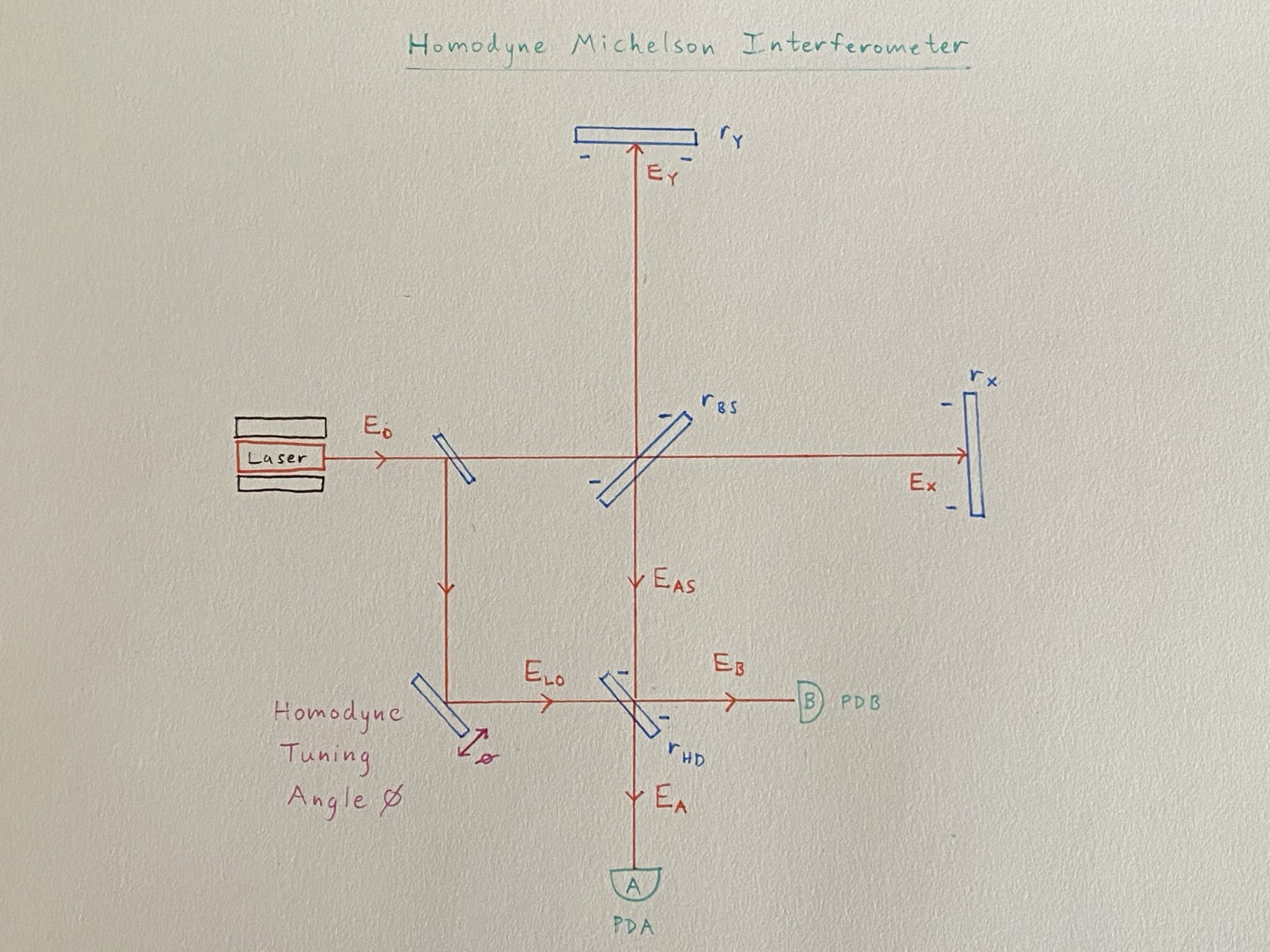
Michelson Interferometers, Modulations, and Transfer Functions - Homework 03 Professor Craig Cahillane February 16, 2025
This is the third homework assignment for Lasers and Optomechanics at Syracuse University.It is due Monday, March 02, 2026 by 5 pm
You will need to complete the questions in this jupyter notebook and submit it via gitlab
%matplotlib widget
from ipywidgets import *

import sympy as sp
import numpy as np
import matplotlib as mpl
import matplotlib.pyplot as plt

sp.init_printing(use_latex='mathjax')

plt.style.use('dark_background')

fontsize = 14
mpl.rcParams.update(
    {
        "text.usetex": True,
        "figure.figsize": (9, 6),
        "figure.autolayout": True,
        "font.family": "serif",
        "font.serif": "georgia",
        "lines.linewidth": 1.5,
        "font.size": fontsize,
        "xtick.labelsize": fontsize,
        "ytick.labelsize": fontsize,
        "legend.fancybox": True,
        "legend.fontsize": fontsize,
        "legend.framealpha": 0.7,
        "legend.handletextpad": 0.5,
        "legend.labelspacing": 0.2,
        "legend.loc": "best",
        "axes.edgecolor": "#b0b0b0",
        "grid.color": "#707070",
        "xtick.color": "#b0b0b0",
        "ytick.color": "#b0b0b0",
        "savefig.dpi": 80,
        "pdf.compression": 9,
    }
)
Homodyne Michelson Interferometer Diagram
1.1 Adjacency Matrix ¶ Set up an Adjacency Matrix M \boldsymbol{M} M ϕ H D \phi_\mathrm{HD} ϕ HD E L O E_\mathrm{LO} E LO
E L O = − r L O e − i ϕ H D E i n \begin{align}
E_\mathrm{LO} = -r_\mathrm{LO} e^{-i \phi_\mathrm{HD}} E_\mathrm{in}
\end{align} E LO = − r LO e − i ϕ HD E in 1.2 Electric Field Transfer Functions ¶ Invert your Adjacency Matrix minus the identity ( M − I ) − 1 (\boldsymbol{M} - \boldsymbol{I})^{-1} ( M − I ) − 1 P D A \mathrm{PD}_A PD A P D B \mathrm{PD}_B PD B E P D A E i n \dfrac{E_\mathrm{PDA}}{E_\mathrm{in}} E in E PDA E P D B E i n \dfrac{E_\mathrm{PDB}}{E_\mathrm{in}} E in E PDB
1.3 Substitutions ¶ Apply the phase change of basis used in class ϕ d = ϕ x − ϕ y 2 \phi_d = \dfrac{\phi_x - \phi_y}{2} ϕ d = 2 ϕ x − ϕ y ϕ c = ϕ x − ϕ y 2 \phi_c = \dfrac{\phi_x - \phi_y}{2} ϕ c = 2 ϕ x − ϕ y r B S = t B S = 1 2 r_\mathrm{BS} = t_\mathrm{BS} = \dfrac{1}{\sqrt{2}} r BS = t BS = 2 1
1.4 Power Transfer Functions ¶ Calculate the input to power transfer functions P P D A P i n \dfrac{P_\mathrm{PDA}}{P_\mathrm{in}} P in P PDA P P D B P i n \dfrac{P_\mathrm{PDB}}{P_\mathrm{in}} P in P PDB
1.5 Interpretation ¶ How do P P D A P i n \dfrac{P_\mathrm{PDA}}{P_\mathrm{in}} P in P PDA P P D B P i n \dfrac{P_\mathrm{PDB}}{P_\mathrm{in}} P in P PDB ϕ H D \phi_\mathrm{HD} ϕ HD ϕ d \phi_d ϕ d ϕ c \phi_c ϕ c ϕ H D \phi_\mathrm{HD} ϕ HD ϕ d \phi_d ϕ d
2 Homodyne Michelson Solution ¶ 2.1 Part A: Adjacency Matrix ¶ First, create the electric field vector E ⃗ \vec{E} E
Symbol Description E 1 E_1 E 1 Input field E 2 E_2 E 2 Field incident on Michelson beamsplitter E 3 E_3 E 3 Field in X-arm, incident on end mirror − r x -r_x − r x E 4 E_4 E 4 Field in Y-arm, incident on end mirror − r y -r_y − r y E 5 E_5 E 5 Field returning from X-arm to BS E 6 E_6 E 6 Field returning from Y-arm to BS E 7 E_7 E 7 Antisymmetric port field E a s E_\mathrm{as} E as E 8 E_8 E 8 Local oscillator field E l o E_\mathrm{lo} E lo E 9 E_9 E 9 Field at photodetector A, E A E_A E A E 10 E_{10} E 10 Field at photodetector B, E B E_B E B
Optical elements:
M 1 M_1 M 1 ( r m 1 , t m 1 ) (r_{m1},\, t_{m1}) ( r m 1 , t m 1 )
M 2 M_2 M 2 ϕ h d \phi_\mathrm{hd} ϕ hd r m 2 r_{m2} r m 2
M 3 M_3 M 3 E a s E_\mathrm{as} E as E l o E_\mathrm{lo} E lo ( r h d , t h d ) (r_\mathrm{hd},\, t_\mathrm{hd}) ( r hd , t hd )
The 10 × 10 10\times10 10 × 10 E 1 , … , E 10 E_1,\ldots,E_{10} E 1 , … , E 10
M = ( 0 0 0 0 0 0 0 0 0 0 t m 1 0 0 0 0 0 0 0 0 0 0 t b s e − i ϕ x 0 0 0 0 0 0 0 0 0 − r b s e − i ϕ y 0 0 0 0 0 0 0 0 0 0 − r x e − i ϕ x 0 0 0 0 0 0 0 0 0 0 − r y e − i ϕ y 0 0 0 0 0 0 0 0 0 0 r b s t b s 0 0 0 0 r m 1 r m 2 e − i ϕ h d 0 0 0 0 0 0 0 0 0 0 0 0 0 0 0 t h d r h d 0 0 0 0 0 0 0 0 − r h d t h d 0 0 ) ( E 1 E 2 E 3 E 4 E 5 E 6 E 7 E 8 E 9 E 10 ) M = \begin{pmatrix}
0 & 0 & 0 & 0 & 0 & 0 & 0 & 0 & 0 & 0 \\
t_{m1} & 0 & 0 & 0 & 0 & 0 & 0 & 0 & 0 & 0 \\
0 & t_\mathrm{bs} e^{-i\phi_x} & 0 & 0 & 0 & 0 & 0 & 0 & 0 & 0 \\
0 & -r_\mathrm{bs} e^{-i\phi_y} & 0 & 0 & 0 & 0 & 0 & 0 & 0 & 0 \\
0 & 0 & -r_x e^{-i\phi_x} & 0 & 0 & 0 & 0 & 0 & 0 & 0 \\
0 & 0 & 0 & -r_y e^{-i\phi_y} & 0 & 0 & 0 & 0 & 0 & 0 \\
0 & 0 & 0 & 0 & r_\mathrm{bs} & t_\mathrm{bs} & 0 & 0 & 0 & 0 \\
r_{m1} r_{m2} e^{-i\phi_\mathrm{hd}} & 0 & 0 & 0 & 0 & 0 & 0 & 0 & 0 & 0 \\
0 & 0 & 0 & 0 & 0 & 0 & t_\mathrm{hd} & r_\mathrm{hd} & 0 & 0 \\
0 & 0 & 0 & 0 & 0 & 0 & -r_\mathrm{hd} & t_\mathrm{hd} & 0 & 0
\end{pmatrix} \begin{pmatrix}
E_1\\
E_2\\
E_3\\
E_4\\
E_5\\
E_6\\
E_7\\
E_8\\
E_9\\
E_{10}
\end{pmatrix} M = ⎝ ⎛ 0 t m 1 0 0 0 0 0 r m 1 r m 2 e − i ϕ hd 0 0 0 0 t bs e − i ϕ x − r bs e − i ϕ y 0 0 0 0 0 0 0 0 0 0 − r x e − i ϕ x 0 0 0 0 0 0 0 0 0 0 − r y e − i ϕ y 0 0 0 0 0 0 0 0 0 0 r bs 0 0 0 0 0 0 0 0 0 t bs 0 0 0 0 0 0 0 0 0 0 0 t hd − r hd 0 0 0 0 0 0 0 0 r hd t hd 0 0 0 0 0 0 0 0 0 0 0 0 0 0 0 0 0 0 0 0 ⎠ ⎞ ⎝ ⎛ E 1 E 2 E 3 E 4 E 5 E 6 E 7 E 8 E 9 E 10 ⎠ ⎞ Reading off this matrix, for example E 10 = − r h d E 7 + t h d E 8 E_{10} = -r_\mathrm{hd} E_7 + t_\mathrm{hd} E_8 E 10 = − r hd E 7 + t hd E 8 E 10 = E B E_{10} = E_B E 10 = E B E 7 = E a s E_7 = E_{as} E 7 = E a s E 8 = E l o E_8 = E_{lo} E 8 = E l o
E B = − r h d E a s + t h d E l o E_B = -r_\mathrm{hd} E_{as} + t_\mathrm{hd} E_{lo} E B = − r hd E a s + t hd E l o Inverting this matrix minus the identity gives us our transfer functions:
G = ( M − I ) − 1 ( − 1 0 0 0 0 0 0 0 0 0 − t m1 − 1 0 0 0 0 0 0 0 0 t bs t m1 ( − e − i ϕ x ) t bs ( − e − i ϕ x ) − 1 0 0 0 0 0 0 0 r bs t m1 e − i ϕ y r bs e − i ϕ y 0 − 1 0 0 0 0 0 0 t bs t m1 r x e − 2 i ϕ x t bs r x e − 2 i ϕ x r x e − i ϕ x 0 − 1 0 0 0 0 0 r bs t m1 r y ( − e − 2 i ϕ y ) r bs r y ( − e − 2 i ϕ y ) 0 r y e − i ϕ y 0 − 1 0 0 0 0 r bs t bs t m1 ( r x e − 2 i ϕ x − r y e − 2 i ϕ y ) r bs t bs ( r x e − 2 i ϕ x − r y e − 2 i ϕ y ) r bs r x e − i ϕ x t bs r y e − i ϕ y − r bs − t bs − 1 0 0 0 − e − i ϕ hd r m1 r m2 0 0 0 0 0 0 − 1 0 0 r bs t bs t hd t m1 r x e − 2 i ϕ x − r bs t bs t hd t m1 r y e − 2 i ϕ y + r hd ( − e − i ϕ hd ) r m1 r m2 r bs t bs t hd ( r x e − 2 i ϕ x − r y e − 2 i ϕ y ) r bs t hd r x e − i ϕ x t bs t hd r y e − i ϕ y − r bs t hd − t bs t hd − t hd − r hd − 1 0 − r bs t bs r hd t m1 r x e − 2 i ϕ x + r bs t bs r hd t m1 r y e − 2 i ϕ y + t hd ( − e − i ϕ hd ) r m1 r m2 r bs t bs r hd ( r y e − 2 i ϕ y − r x e − 2 i ϕ x ) r bs r hd r x ( − e − i ϕ x ) t bs r hd r y ( − e − i ϕ y ) r bs r hd t bs r hd r hd − t hd 0 − 1 ) G = (M - I)^{-1}\left(
\begin{array}{cccccccccc}
-1 & 0 & 0 & 0 & 0 & 0 & 0 & 0 & 0 & 0 \\
-t_{\text{m1}} & -1 & 0 & 0 & 0 & 0 & 0 & 0 & 0 & 0 \\
t_{\text{bs}} t_{\text{m1}} \left(-e^{-i \phi _x}\right) & t_{\text{bs}} \left(-e^{-i \phi _x}\right) & -1 & 0 & 0 & 0 & 0 & 0 & 0 & 0 \\
r_{\text{bs}} t_{\text{m1}} e^{-i \phi _y} & r_{\text{bs}} e^{-i \phi _y} & 0 & -1 & 0 & 0 & 0 & 0 & 0 & 0 \\
t_{\text{bs}} t_{\text{m1}} r_x e^{-2 i \phi _x} & t_{\text{bs}} r_x e^{-2 i \phi _x} & r_x e^{-i \phi _x} & 0 & -1 & 0 & 0 & 0 & 0 & 0 \\
r_{\text{bs}} t_{\text{m1}} r_y \left(-e^{-2 i \phi _y}\right) & r_{\text{bs}} r_y \left(-e^{-2 i \phi _y}\right) & 0 & r_y e^{-i \phi _y} & 0 & -1 & 0 & 0 & 0 & 0 \\
r_{\text{bs}} t_{\text{bs}} t_{\text{m1}} \left(r_x e^{-2 i \phi _x}-r_y e^{-2 i \phi _y}\right) & r_{\text{bs}} t_{\text{bs}} \left(r_x e^{-2 i \phi _x}-r_y e^{-2 i \phi _y}\right) & r_{\text{bs}} r_x e^{-i
\phi _x} & t_{\text{bs}} r_y e^{-i \phi _y} & -r_{\text{bs}} & -t_{\text{bs}} & -1 & 0 & 0 & 0 \\
-e^{-i \phi _{\text{hd}}} r_{\text{m1}} r_{\text{m2}} & 0 & 0 & 0 & 0 & 0 & 0 & -1 & 0 & 0 \\
r_{\text{bs}} t_{\text{bs}} t_{\text{hd}} t_{\text{m1}} r_x e^{-2 i \phi _x}-r_{\text{bs}} t_{\text{bs}} t_{\text{hd}} t_{\text{m1}} r_y e^{-2 i \phi _y}+r_{\text{hd}} \left(-e^{-i \phi _{\text{hd}}}\right)
r_{\text{m1}} r_{\text{m2}} & r_{\text{bs}} t_{\text{bs}} t_{\text{hd}} \left(r_x e^{-2 i \phi _x}-r_y e^{-2 i \phi _y}\right) & r_{\text{bs}} t_{\text{hd}} r_x e^{-i \phi _x} & t_{\text{bs}} t_{\text{hd}}
r_y e^{-i \phi _y} & -r_{\text{bs}} t_{\text{hd}} & -t_{\text{bs}} t_{\text{hd}} & -t_{\text{hd}} & -r_{\text{hd}} & -1 & 0 \\
-r_{\text{bs}} t_{\text{bs}} r_{\text{hd}} t_{\text{m1}} r_x e^{-2 i \phi _x}+r_{\text{bs}} t_{\text{bs}} r_{\text{hd}} t_{\text{m1}} r_y e^{-2 i \phi _y}+t_{\text{hd}} \left(-e^{-i \phi _{\text{hd}}}\right)
r_{\text{m1}} r_{\text{m2}} & r_{\text{bs}} t_{\text{bs}} r_{\text{hd}} \left(r_y e^{-2 i \phi _y}-r_x e^{-2 i \phi _x}\right) & r_{\text{bs}} r_{\text{hd}} r_x \left(-e^{-i \phi _x}\right) & t_{\text{bs}}
r_{\text{hd}} r_y \left(-e^{-i \phi _y}\right) & r_{\text{bs}} r_{\text{hd}} & t_{\text{bs}} r_{\text{hd}} & r_{\text{hd}} & -t_{\text{hd}} & 0 & -1 \\
\end{array}
\right) G = ( M − I ) − 1 ⎝ ⎛ − 1 − t m1 t bs t m1 ( − e − i ϕ x ) r bs t m1 e − i ϕ y t bs t m1 r x e − 2 i ϕ x r bs t m1 r y ( − e − 2 i ϕ y ) r bs t bs t m1 ( r x e − 2 i ϕ x − r y e − 2 i ϕ y ) − e − i ϕ hd r m1 r m2 r bs t bs t hd t m1 r x e − 2 i ϕ x − r bs t bs t hd t m1 r y e − 2 i ϕ y + r hd ( − e − i ϕ hd ) r m1 r m2 − r bs t bs r hd t m1 r x e − 2 i ϕ x + r bs t bs r hd t m1 r y e − 2 i ϕ y + t hd ( − e − i ϕ hd ) r m1 r m2 0 − 1 t bs ( − e − i ϕ x ) r bs e − i ϕ y t bs r x e − 2 i ϕ x r bs r y ( − e − 2 i ϕ y ) r bs t bs ( r x e − 2 i ϕ x − r y e − 2 i ϕ y ) 0 r bs t bs t hd ( r x e − 2 i ϕ x − r y e − 2 i ϕ y ) r bs t bs r hd ( r y e − 2 i ϕ y − r x e − 2 i ϕ x ) 0 0 − 1 0 r x e − i ϕ x 0 r bs r x e − i ϕ x 0 r bs t hd r x e − i ϕ x r bs r hd r x ( − e − i ϕ x ) 0 0 0 − 1 0 r y e − i ϕ y t bs r y e − i ϕ y 0 t bs t hd r y e − i ϕ y t bs r hd r y ( − e − i ϕ y ) 0 0 0 0 − 1 0 − r bs 0 − r bs t hd r bs r hd 0 0 0 0 0 − 1 − t bs 0 − t bs t hd t bs r hd 0 0 0 0 0 0 − 1 0 − t hd r hd 0 0 0 0 0 0 0 − 1 − r hd − t hd 0 0 0 0 0 0 0 0 − 1 0 0 0 0 0 0 0 0 0 0 − 1 ⎠ ⎞ 2.2 Part B: Electric Field Transfer Functions ¶ From our matrix inversion, we can pick off the last two rows and first column elements G 9 , 1 G_{9,1} G 9 , 1 G 10 , 1 G_{10,1} G 10 , 1
E A E i n = G 9 , 1 , E B E i n = G 10 , 1 \dfrac{E_A}{E_\mathrm{in}} = G_{9,1}, \qquad \dfrac{E_B}{E_\mathrm{in}} = G_{10,1} E in E A = G 9 , 1 , E in E B = G 10 , 1 E A E i n = r bs t bs t hd t m1 r x e − 2 i ϕ x − r bs t bs t hd t m1 r y e − 2 i ϕ y − r hd r m1 r m2 e − i ϕ hd E B E i n = − r bs t bs r hd t m1 r x e − 2 i ϕ x + r bs t bs r hd t m1 r y e − 2 i ϕ y − t hd r m1 r m2 e − i ϕ hd \begin{align}
\dfrac{E_A}{E_\mathrm{in}} &= r_{\text{bs}} t_{\text{bs}} t_{\text{hd}} t_{\text{m1}} r_x e^{-2 i \phi _x}-r_{\text{bs}} t_{\text{bs}} t_{\text{hd}} t_{\text{m1}} r_y e^{-2 i \phi _y} - r_{\text{hd}} r_{\text{m1}} r_{\text{m2}} e^{-i \phi _{\text{hd}}}\\
\dfrac{E_B}{E_\mathrm{in}} &= -r_{\text{bs}} t_{\text{bs}} r_{\text{hd}} t_{\text{m1}} r_x e^{-2 i \phi _x}+r_{\text{bs}} t_{\text{bs}} r_{\text{hd}} t_{\text{m1}} r_y e^{-2 i \phi _y} - t_{\text{hd}} r_{\text{m1}} r_{\text{m2}} e^{-i \phi _{\text{hd}}}\\
\end{align} E in E A E in E B = r bs t bs t hd t m1 r x e − 2 i ϕ x − r bs t bs t hd t m1 r y e − 2 i ϕ y − r hd r m1 r m2 e − i ϕ hd = − r bs t bs r hd t m1 r x e − 2 i ϕ x + r bs t bs r hd t m1 r y e − 2 i ϕ y − t hd r m1 r m2 e − i ϕ hd 2.3 Part C: Substitutions ¶ Physically motivated simplifications:
Phase basis change: ϕ x = ϕ c + ϕ d \phi_x = \phi_c + \phi_d ϕ x = ϕ c + ϕ d ϕ y = ϕ c − ϕ d \;\phi_y = \phi_c - \phi_d ϕ y = ϕ c − ϕ d
Ideal 50:50 Michelson BS: t b s = r b s = 1 / 2 t_\mathrm{bs} = r_\mathrm{bs} = 1/\sqrt{2} t bs = r bs = 1/ 2
Perfect end mirrors: r x = r y = 1 r_x = r_y = 1 r x = r y = 1
Perfect steering mirror: r m 2 = 1 r_{m2} = 1 r m 2 = 1
Ideal 50:50 homodyne BS: t h d = r h d = 1 / 2 t_\mathrm{hd} = r_\mathrm{hd} = 1/\sqrt{2} t hd = r hd = 1/ 2
Ideal 50:50 input BS: t m 1 = r m 1 = 1 / 2 t_{m1} = r_{m1} = 1/\sqrt{2} t m 1 = r m 1 = 1/ 2
E A E i n = 1 4 ( − e − i 2 ( ϕ c − ϕ d ) + e − i 2 ( ϕ c + ϕ d ) − 2 e − i ϕ h d ) E B E i n = 1 4 ( e − i 2 ( ϕ c − ϕ d ) − e − i 2 ( ϕ c + ϕ d ) − 2 e − i ϕ h d ) \begin{align}
\dfrac{E_A}{E_\mathrm{in}} &= \dfrac{1}{4} \left( -e^{-i 2 (\phi_c - \phi_d)} + e^{-i 2 (\phi_c + \phi_d)} - 2 e^{-i \phi_{hd}} \right)\\
\dfrac{E_B}{E_\mathrm{in}} &= \dfrac{1}{4} \left( e^{-i 2 (\phi_c - \phi_d)} - e^{-i 2 (\phi_c + \phi_d)} - 2 e^{-i \phi_{hd}} \right)\\
\end{align} E in E A E in E B = 4 1 ( − e − i 2 ( ϕ c − ϕ d ) + e − i 2 ( ϕ c + ϕ d ) − 2 e − i ϕ h d ) = 4 1 ( e − i 2 ( ϕ c − ϕ d ) − e − i 2 ( ϕ c + ϕ d ) − 2 e − i ϕ h d ) 2.4 Part D: Power Transfer Functions ¶ (Assume that E i n = 1 W E_\mathrm{in} = 1~\sqrt{\mathrm{W}} E in = 1 W P i n = 1 W P_\mathrm{in} = 1~\mathrm{W} P in = 1 W
Derivation for P A P_A P A
E A = 1 4 [ − e − i 2 ( ϕ c − ϕ d ) + e − i 2 ( ϕ c + ϕ d ) − 2 e − i ϕ h d ] E A = 1 4 e − i 2 ϕ c [ − e i 2 ϕ d + e − i 2 ϕ d − 2 e − i ( ϕ h d − 2 ϕ c ) ] E A = 1 4 e − i 2 ϕ c [ − i 2 sin ( 2 ϕ d ) − 2 e − i ( ϕ h d − 2 ϕ c ) ] E A = 1 2 e − i 2 ϕ c [ − i sin ( 2 ϕ d ) − e − i ( ϕ h d − 2 ϕ c ) ] P A = ∣ E A ∣ 2 P A = 1 4 [ − i sin ( 2 ϕ d ) − e − i ( ϕ h d − 2 ϕ c ) ] [ i sin ( 2 ϕ d ) − e i ( ϕ h d − 2 ϕ c ) ] P A = 1 4 [ sin 2 ( 2 ϕ d ) + 1 − i sin ( 2 ϕ d ) e − i ( ϕ h d − 2 ϕ c ) + i sin ( 2 ϕ d ) e i ( ϕ h d − 2 ϕ c ) ] P A = 1 4 [ 1 + sin 2 ( 2 ϕ d ) + i sin ( 2 ϕ d ) ( i 2 sin ( ϕ h d − 2 ϕ c ) ) ] P A = 1 4 [ 1 + sin 2 ( 2 ϕ d ) − 2 sin ( 2 ϕ d ) sin ( ϕ h d − 2 ϕ c ) ] P A = 1 4 [ 1 + sin 2 ( 2 ϕ d ) + 2 sin ( 2 ϕ d ) sin ( 2 ϕ c − ϕ h d ) ] \begin{align}
E_A &= \dfrac{1}{4} \left[ -e^{-i 2 (\phi_c - \phi_d)} + e^{-i 2 (\phi_c + \phi_d)} - 2 e^{-i \phi_{hd} } \right]\\
E_A &= \dfrac{1}{4} e^{-i 2 \phi_c} \left[ -e^{i 2 \phi_d} + e^{-i 2 \phi_d} - 2 e^{-i (\phi_{hd} - 2\phi_c) } \right]\\
E_A &= \dfrac{1}{4} e^{-i 2 \phi_c} \left[ -i 2 \sin(2 \phi_d) - 2 e^{-i (\phi_{hd} - 2\phi_c) } \right]\\
E_A &= \dfrac{1}{2} e^{-i 2 \phi_c} \left[ -i \sin(2 \phi_d) - e^{-i (\phi_{hd} - 2\phi_c) } \right]\\~\\
P_A &= \left|E_A\right|^2\\
P_A &= \dfrac{1}{4} \left[ -i \sin(2 \phi_d) - e^{-i (\phi_{hd} - 2\phi_c) } \right] \left[ i \sin(2 \phi_d) - e^{i (\phi_{hd} - 2\phi_c) } \right]\\
P_A &= \dfrac{1}{4} \left[ \sin^2(2 \phi_d) + 1 - i \sin(2 \phi_d) e^{-i (\phi_{hd} - 2\phi_c) } + i \sin(2 \phi_d) e^{i (\phi_{hd} - 2\phi_c) } \right]\\
P_A &= \dfrac{1}{4} \left[ 1 + \sin^2(2 \phi_d) + i \sin(2 \phi_d) (i 2 \sin(\phi_{hd} - 2\phi_c)) \right]\\
P_A &= \dfrac{1}{4} \left[ 1 + \sin^2(2 \phi_d) - 2 \sin(2 \phi_d) \sin(\phi_{hd} - 2\phi_c) \right]\\
P_A &= \dfrac{1}{4} \left[ 1 + \sin^2(2 \phi_d) + 2 \sin(2 \phi_d) \sin(2\phi_c - \phi_{hd}) \right]
\end{align} E A E A E A E A P A P A P A P A P A P A = 4 1 [ − e − i 2 ( ϕ c − ϕ d ) + e − i 2 ( ϕ c + ϕ d ) − 2 e − i ϕ h d ] = 4 1 e − i 2 ϕ c [ − e i 2 ϕ d + e − i 2 ϕ d − 2 e − i ( ϕ h d − 2 ϕ c ) ] = 4 1 e − i 2 ϕ c [ − i 2 sin ( 2 ϕ d ) − 2 e − i ( ϕ h d − 2 ϕ c ) ] = 2 1 e − i 2 ϕ c [ − i sin ( 2 ϕ d ) − e − i ( ϕ h d − 2 ϕ c ) ] = ∣ E A ∣ 2 = 4 1 [ − i sin ( 2 ϕ d ) − e − i ( ϕ h d − 2 ϕ c ) ] [ i sin ( 2 ϕ d ) − e i ( ϕ h d − 2 ϕ c ) ] = 4 1 [ sin 2 ( 2 ϕ d ) + 1 − i sin ( 2 ϕ d ) e − i ( ϕ h d − 2 ϕ c ) + i sin ( 2 ϕ d ) e i ( ϕ h d − 2 ϕ c ) ] = 4 1 [ 1 + sin 2 ( 2 ϕ d ) + i sin ( 2 ϕ d ) ( i 2 sin ( ϕ h d − 2 ϕ c )) ] = 4 1 [ 1 + sin 2 ( 2 ϕ d ) − 2 sin ( 2 ϕ d ) sin ( ϕ h d − 2 ϕ c ) ] = 4 1 [ 1 + sin 2 ( 2 ϕ d ) + 2 sin ( 2 ϕ d ) sin ( 2 ϕ c − ϕ h d ) ] The normalised powers P A = ∣ E A ∣ 2 P_A = \left|E_A\right|^2 P A = ∣ E A ∣ 2 P B = ∣ E B ∣ 2 P_B = \left|E_B\right|^2 P B = ∣ E B ∣ 2
P A = 1 4 [ 1 + sin 2 ( 2 ϕ d ) + 2 sin ( 2 ϕ d ) sin ( 2 ϕ c − ϕ h d ) ] \boxed{P_A = \frac{1}{4}\!\left[1 + \sin^2(2\phi_d) + 2\sin(2\phi_d)\sin(2\phi_c - \phi_\mathrm{hd})\right]} P A = 4 1 [ 1 + sin 2 ( 2 ϕ d ) + 2 sin ( 2 ϕ d ) sin ( 2 ϕ c − ϕ hd ) ] P B = 1 4 [ 1 + sin 2 ( 2 ϕ d ) − 2 sin ( 2 ϕ d ) sin ( 2 ϕ c − ϕ h d ) ] \boxed{P_B = \frac{1}{4}\!\left[1 + \sin^2(2\phi_d) - 2\sin(2\phi_d)\sin(2\phi_c - \phi_\mathrm{hd})\right]} P B = 4 1 [ 1 + sin 2 ( 2 ϕ d ) − 2 sin ( 2 ϕ d ) sin ( 2 ϕ c − ϕ hd ) ] Analyzing the above, what is actually most useful as an error signal is the power sum P s u m = P A + P B P_\mathrm{sum} = P_A + P_B P sum = P A + P B P d i f f = P A − P B P_\mathrm{diff} = P_A - P_B P diff = P A − P B
P s u m = 1 4 [ 1 + sin 2 ( 2 ϕ d ) ] \boxed{P_\mathrm{sum} = \frac{1}{4}\!\left[1 + \sin^2(2\phi_d)\right]} P sum = 4 1 [ 1 + sin 2 ( 2 ϕ d ) ] P d i f f = sin ( 2 ϕ d ) sin ( 2 ϕ c − ϕ h d ) \boxed{P_\mathrm{diff} = \sin(2\phi_d)\,\sin(2\phi_c - \phi_\mathrm{hd})} P diff = sin ( 2 ϕ d ) sin ( 2 ϕ c − ϕ hd ) Setting ϕ h d = 2 ϕ c − π / 2 \phi_\mathrm{hd} = 2\phi_c - \pi/2 ϕ hd = 2 ϕ c − π /2 ϕ d \phi_d ϕ d
P d i f f ∣ o p t = sin ( 2 ϕ d ) P_\mathrm{diff}\big|_\mathrm{opt} = \sin(2\phi_d) P diff ∣ ∣ opt = sin ( 2 ϕ d ) 2.5 Plots ¶ Plot 1: Power vs Differential Phase ϕ d \phi_d ϕ d ¶ Optimal homodyne angle ϕ h d = 2 ϕ c − π / 2 \phi_\mathrm{hd} = 2\phi_c - \pi/2 ϕ hd = 2 ϕ c − π /2 ϕ c = 0 \phi_c = 0 ϕ c = 0
P A − P B = sin ( 2 ϕ d ) P_A - P_B = \sin(2\phi_d) P A − P B = sin ( 2 ϕ d ) ϕ d = 0 \phi_d = 0 ϕ d = 0 dark-fringe locking .
phi_d_arr  = np.linspace(-np.pi, np.pi, 1000)
phi_c_arr  = np.linspace(-np.pi, np.pi, 1000)
phi_hd_arr = np.linspace(-np.pi, np.pi, 1000)
def Pa_np(pc,pd,phd): return (3-np.cos(4*pd)+4*np.sin(2*pd)*np.sin(2*pc-phd))/8
def Pb_np(pc,pd,phd): return (3-np.cos(4*pd)-4*np.sin(2*pd)*np.sin(2*pc-phd))/8
# Plot 1 -- vs phi_d, optimal homodyne angle
pc0 = 0.0
phd_opt = 2*pc0 - np.pi/2

fig, ax = plt.subplots()
pa = Pa_np(pc0, phi_d_arr, phd_opt)
pb = Pb_np(pc0, phi_d_arr, phd_opt)
ax.plot(phi_d_arr, pa,    lw=2,          label=r'$P_A$')
ax.plot(phi_d_arr, pb,    lw=2,          label=r'$P_B$')
ax.plot(phi_d_arr, pa+pb, lw=2, ls='--', label=r'$P_A+P_B$')
ax.plot(phi_d_arr, pa-pb, lw=2, ls='-.', label=r'$P_A-P_B$')
ax.axhline(0, color='w', lw=0.7)
ax.axvline(0, color='w', lw=0.7, ls=':')
ax.set_xlabel(r'Differential phase $\phi_d$ [rad]')
ax.set_ylabel('Normalised Power')
ax.set_title(r'Power vs $\phi_d$  ($\phi_\mathrm{hd} = 2\phi_c - \pi/2$, $\phi_c=0$)')
ax.set_xticks([-np.pi,-np.pi/2,0,np.pi/2,np.pi])
ax.set_xticklabels([r'$-\pi$',r'$-\pi/2$','$0$',r'$\pi/2$',r'$\pi$'])
ax.legend(loc='upper right')
ax.grid()
plt.tight_layout()
# plt.savefig('plot1_vs_phid.png', bbox_inches='tight')
plt.show()
print("P_A - P_B crosses zero at phi_d = 0: ideal dark-fringe error signal.")
P_A - P_B crosses zero at phi_d = 0: ideal dark-fringe error signal.
Plot 2: Power vs Common Phase ϕ c \phi_c ϕ c ¶ ϕ d = π / 4 \phi_d = \pi/4 ϕ d = π /4 ϕ h d = 0 \phi_\mathrm{hd} = 0 ϕ hd = 0
The common phase ϕ c \phi_c ϕ c sum P A + P B P_A+P_B P A + P B .
phi_d_bright = np.pi/4

fig2, ax2 = plt.subplots()
pa2 = Pa_np(phi_c_arr, phi_d_bright, 0.0)
pb2 = Pb_np(phi_c_arr, phi_d_bright, 0.0)
ax2.plot(phi_c_arr, pa2,     lw=2,          label=r'$P_A$')
ax2.plot(phi_c_arr, pb2,     lw=2,          label=r'$P_B$')
ax2.plot(phi_c_arr, pa2+pb2, lw=2, ls='--', label=r'$P_A+P_B$')
ax2.plot(phi_c_arr, pa2-pb2, lw=2, ls='-.', label=r'$P_A-P_B$')
ax2.axhline(0, color='w', lw=0.7)
ax2.set_xlabel(r'Common phase $\phi_c$ [rad]')
ax2.set_ylabel('Normalised Power')
ax2.set_title(r'Power vs $\phi_c$  ($\phi_d=\pi/4$, $\phi_\mathrm{hd}=0$)')
ax2.set_xticks([-np.pi,-np.pi/2,0,np.pi/2,np.pi])
ax2.set_xticklabels([r'$-\pi$',r'$-\pi/2$','$0$',r'$\pi/2$',r'$\pi$'])
ax2.legend(loc='upper right')
ax2.grid()
plt.tight_layout()
# plt.savefig('plot2_vs_phic.png', bbox_inches='tight')
plt.show()
Plot 3: Power vs Homodyne Angle ϕ h d \phi_\mathrm{hd} ϕ hd ¶ ϕ d = π / 4 \phi_d = \pi/4 ϕ d = π /4 ϕ c = 0 \phi_c = 0 ϕ c = 0
Sweeping ϕ h d \phi_\mathrm{hd} ϕ hd E a s E_\mathrm{as} E as E l o E_\mathrm{lo} E lo
Note: This sweep only works on a bright fringe -- if the Michelson is dark
(E a s = 0 E_\mathrm{as}=0 E as = 0 coherent locking field (CLF) : an RF-modulated sideband co-propagating with
squeezed light that provides a homodyne angle reference even on the dark fringe.
fig, ax3 = plt.subplots()
pa3 = Pa_np(0.0, phi_d_bright, phi_hd_arr)
pb3 = Pb_np(0.0, phi_d_bright, phi_hd_arr)
ax3.plot(phi_hd_arr, pa3,     lw=2,          label=r'$P_A$')
ax3.plot(phi_hd_arr, pb3,     lw=2,          label=r'$P_B$')
ax3.plot(phi_hd_arr, pa3+pb3, lw=2, ls='--', label=r'$P_A+P_B$')
ax3.plot(phi_hd_arr, pa3-pb3, lw=2, ls='-.', label=r'$P_A-P_B$')
ax3.axhline(0, color='w', lw=0.7)
ax3.set_xlabel(r'Homodyne angle $\phi_\mathrm{hd}$ [rad]')
ax3.set_ylabel('Normalised Power')
ax3.set_title(r'Power vs $\phi_\mathrm{hd}$  ($\phi_d=\pi/4$, $\phi_c=0$)')
ax3.set_xticks([-np.pi,-np.pi/2,0,np.pi/2,np.pi])
ax3.set_xticklabels([r'$-\pi$',r'$-\pi/2$','$0$',r'$\pi/2$',r'$\pi$'])
ax3.legend(loc='upper right')
ax3.grid()
plt.tight_layout()
# plt.savefig('plot3_vs_phihd.png', bbox_inches='tight')
plt.show()
Relaxing the 50:50 assumption on M 1 M_1 M 1 r m 1 r_{m1} r m 1 t m 1 t_{m1} t m 1 r m 1 2 + t m 1 2 = 1 r_{m1}^2 + t_{m1}^2 = 1 r m 1 2 + t m 1 2 = 1 E A E_A E A E B E_B E B
E A = e − i ( 2 ϕ c + 2 ϕ d + ϕ hd ) ( − 2 r m1 e 2 i ( ϕ c + ϕ d ) − t m1 e i ( 4 ϕ d + ϕ hd ) + e i ϕ hd t m1 ) 2 2 E B = e − i ( 2 ϕ c + 2 ϕ d + ϕ hd ) ( − 2 r m1 e 2 i ( ϕ c + ϕ d ) + t m1 e i ( 4 ϕ d + ϕ hd ) − e i ϕ hd t m1 ) 2 2 \begin{align}
E_A &= \frac{e^{-i \left(2 \phi _c+2 \phi _d+\phi _{\text{hd}}\right)} \left(-2 r_{\text{m1}} e^{2 i \left(\phi _c+\phi _d\right)}-t_{\text{m1}} e^{i \left(4 \phi _d+\phi _{\text{hd}}\right)}+e^{i \phi _{\text{hd}}}
t_{\text{m1}}\right)}{2 \sqrt{2}}\\
E_B &= \frac{e^{-i \left(2 \phi _c+2 \phi _d+\phi _{\text{hd}}\right)} \left(-2 r_{\text{m1}} e^{2 i \left(\phi _c+\phi _d\right)}+t_{\text{m1}} e^{i \left(4 \phi _d+\phi _{\text{hd}}\right)}-e^{i \phi _{\text{hd}}}
t_{\text{m1}}\right)}{2 \sqrt{2}}
\end{align} E A E B = 2 2 e − i ( 2 ϕ c + 2 ϕ d + ϕ hd ) ( − 2 r m1 e 2 i ( ϕ c + ϕ d ) − t m1 e i ( 4 ϕ d + ϕ hd ) + e i ϕ hd t m1 ) = 2 2 e − i ( 2 ϕ c + 2 ϕ d + ϕ hd ) ( − 2 r m1 e 2 i ( ϕ c + ϕ d ) + t m1 e i ( 4 ϕ d + ϕ hd ) − e i ϕ hd t m1 ) Turning the crank:
P A = 1 4 ( 4 r m1 t m1 sin ( 2 ϕ d ) sin ( 2 ϕ c − ϕ hd ) − t m1 2 cos ( 4 ϕ d ) + 2 r m1 2 + t m1 2 ) P B = 1 4 ( − t m1 ( 4 r m1 sin ( 2 ϕ d ) sin ( 2 ϕ c − ϕ hd ) + t m1 cos ( 4 ϕ d ) ) + 2 r m1 2 + t m1 2 ) P A + P B = 1 2 ( − t m1 2 cos ( 4 ϕ d ) + 2 r m1 2 + t m1 2 ) P A − P B = 2 r m1 t m1 sin ( 2 ϕ d ) sin ( 2 ϕ c − ϕ hd ) \begin{align}
P_A &= \frac{1}{4} \left(4 r_{\text{m1}} t_{\text{m1}} \sin \left(2 \phi _d\right) \sin \left(2 \phi _c-\phi _{\text{hd}}\right)-t_{\text{m1}}^2 \cos \left(4 \phi _d\right)+2 r_{\text{m1}}^2+t_{\text{m1}}^2\right)\\
P_B &= \frac{1}{4} \left(-t_{\text{m1}} \left(4 r_{\text{m1}} \sin \left(2 \phi _d\right) \sin \left(2 \phi _c-\phi _{\text{hd}}\right)+t_{\text{m1}} \cos \left(4 \phi _d\right)\right)+2
r_{\text{m1}}^2+t_{\text{m1}}^2\right)\\
P_A + P_B &= \frac{1}{2} \left(-t_{\text{m1}}^2 \cos \left(4 \phi _d\right)+2 r_{\text{m1}}^2+t_{\text{m1}}^2\right)\\
P_A - P_B &= 2 r_{\text{m1}} t_{\text{m1}} \sin \left(2 \phi _d\right) \sin \left(2 \phi _c-\phi _{\text{hd}}\right)\\
\end{align} P A P B P A + P B P A − P B = 4 1 ( 4 r m1 t m1 sin ( 2 ϕ d ) sin ( 2 ϕ c − ϕ hd ) − t m1 2 cos ( 4 ϕ d ) + 2 r m1 2 + t m1 2 ) = 4 1 ( − t m1 ( 4 r m1 sin ( 2 ϕ d ) sin ( 2 ϕ c − ϕ hd ) + t m1 cos ( 4 ϕ d ) ) + 2 r m1 2 + t m1 2 ) = 2 1 ( − t m1 2 cos ( 4 ϕ d ) + 2 r m1 2 + t m1 2 ) = 2 r m1 t m1 sin ( 2 ϕ d ) sin ( 2 ϕ c − ϕ hd ) At the optimal homodyne angle ϕ h d = 2 ϕ c − π / 2 \phi_\mathrm{hd} = 2\phi_c - \pi/2 ϕ hd = 2 ϕ c − π /2
P d i f f = 2 r m1 t m1 sin ( 2 ϕ d ) P_\mathrm{diff} = 2 r_{\text{m1}} t_{\text{m1}} \sin \left(2 \phi _d\right) P diff = 2 r m1 t m1 sin ( 2 ϕ d ) Maximising over T m 1 ≡ t m 1 2 T_{m1} \equiv t_{m1}^2 T m 1 ≡ t m 1 2 r m 1 = 1 − T m 1 r_{m1} = \sqrt{1-T_{m1}} r m 1 = 1 − T m 1
d d T m 1 [ 1 − T m 1 T m 1 ] = 0 1 − T m1 T m1 − T m1 1 − T m1 = 0 ⇒ T m 1 = 0.5 \dfrac{d}{dT_{m1}}\!\left[\sqrt{1-T_{m1}}\sqrt{T_{m1}}\right] = 0\\~\\
\frac{\sqrt{1-T_{\text{m1}}}}{\sqrt{T_{\text{m1}}}}-\frac{\sqrt{T_{\text{m1}}}}{\sqrt{1-T_{\text{m1}}}} = 0\\~\\
\;\Rightarrow\; T_{m1} = 0.5 d T m 1 d [ 1 − T m 1 T m 1 ] = 0 T m1 1 − T m1 − 1 − T m1 T m1 = 0 ⇒ T m 1 = 0.5 A 50:50 input beamsplitter gives the maximum sensitivity to differential phase.
Tm1 = np.linspace(0, 1, 1000)
coeff = (np.sqrt(1-Tm1) + np.sqrt(Tm1)) / np.sqrt(2)

fig, ax4 = plt.subplots()
ax4.plot(Tm1, coeff, 'steelblue', lw=2.5)
ax4.axvline(0.5, color='tomato', ls='--', lw=2,
           label=r'$T_{M1}=0.5$ (optimum, coeff $=1$)')
ax4.set_xlabel(r'Input mirror transmission $T_{M1}$')
ax4.set_ylabel(r'$\phi_d$ sensitivity coefficient $(r_{m1}+t_{m1})/\sqrt{2}$')
ax4.set_title(r'$\phi_d$ Sensitivity vs Input Beamsplitter Splitting')
ax4.set_xlim(0,1); ax4.set_ylim(0.70, 1.03)
ax4.legend()
plt.tight_layout()
# plt.savefig('plot4_extra_credit.png', bbox_inches='tight')
plt.show()
print(f"Maximum sensitivity = {max(coeff):.6f} at Tm1 = {Tm1[np.argmax(coeff)]:.3f}")
Maximum sensitivity = 1.000000 at Tm1 = 0.499
Suppose you have a Michelson interferometer with the X-arm much longer than the Y-arm:
In this problem, we will calculate the full frequency response transfer functions of the Michelson
P a s ϕ C A R M ( ω ) a n d P a s ϕ D A R M ( ω ) \dfrac{P_\mathrm{as}}{\phi_\mathrm{CARM}}(\omega) \quad \mathrm{and} \quad
\dfrac{P_\mathrm{as}}{\phi_\mathrm{DARM}}(\omega) ϕ CARM P as ( ω ) and ϕ DARM P as ( ω ) I recommend using an algebra helper like Mathematica or sympy for this problem.
You may convert your answers to LaTeX using TeXform in Mathematica or some such similar function for sympy.
3.1 Field tranfer functions ¶ Derive the electric field transfer functions for the following:
E x E i n , E y E i n , E a s E i n \begin{align}
\dfrac{E_\mathrm{x}}{E_\mathrm{in}}, \dfrac{E_\mathrm{y}}{E_\mathrm{in}}, \dfrac{E_\mathrm{as}}{E_\mathrm{in}}
\end{align} E in E x , E in E y , E in E as where E i n E_\mathrm{in} E in E 0 e i ω 0 t E_0 e^{i \omega_0 t} E 0 e i ω 0 t E x E_\mathrm{x} E x reflected from the X-arm mirror,E y E_\mathrm{y} E y reflected from the Y-arm mirror,E a s E_\mathrm{as} E as
Use r b s , t b s r_\mathrm{bs}, t_\mathrm{bs} r bs , t bs r x , r y r_\mathrm{x}, r_\mathrm{y} r x , r y ϕ x , ϕ y \phi_x, \phi_y ϕ x , ϕ y
3.2 End Mirror Modulation ¶ Now, suppose we apply some common modulation to both end mirrors:
ϕ c ( t ) = ϕ x ( t ) = ϕ y ( t ) = Γ cos ( ω t ) \phi_c(t) = \phi_x(t) = \phi_y(t) = \Gamma \cos(\omega t) ϕ c ( t ) = ϕ x ( t ) = ϕ y ( t ) = Γ cos ( ω t ) Write what the new arm reflected transfer functions are for:
E x E i n , E y E i n \dfrac{E_\mathrm{x}}{E_\mathrm{in}}, \dfrac{E_\mathrm{y}}{E_\mathrm{in}} E in E x , E in E y Hint: Remember that you should end up with three distinct fields at ω 0 \omega_0 ω 0 ω 0 ± ω \omega_0 \pm \omega ω 0 ± ω
3.3 Propagate to the antisymmetric port ¶ Propagate your new transfer functions to the antisymmetric port,
and compute a new E a s E i n \dfrac{E_\mathrm{as}}{E_\mathrm{in}} E in E as
Be careful here.k = ω / c k = \omega/c k = ω / c ϕ = − k L \phi = -k L ϕ = − k L
3.4 Calculate the power response ¶ Calculate the power response to the common motion
P a s P i n \dfrac{P_\mathrm{as}}{P_\mathrm{in}} P in P as
This is a lot of algebra, I recommend Mathematica or sympy to help you make sure you get things right here.Γ cos ( ω t ) \Gamma \cos(\omega t) Γ cos ( ω t )
ϕ x = ϕ c + ϕ d , ϕ y = ϕ c − ϕ d \phi_x = \phi_c + \phi_d, \qquad \phi_y = \phi_c - \phi_d ϕ x = ϕ c + ϕ d , ϕ y = ϕ c − ϕ d You may assume an ideal beamsplitter
r b s = t b s = 1 2 r_\mathrm{bs} = t_\mathrm{bs} = \dfrac{1}{\sqrt{2}} r bs = t bs = 2 1 and balanced arms
r x = t y r_\mathrm{x} = t_\mathrm{y} r x = t y and small modulation from the end mirrors
Γ 2 ≈ 0 \Gamma^2 \approx 0 Γ 2 ≈ 0 Answer:
P a s P i n = r x 2 [ sin 2 ( 2 ϕ d ) − 2 Γ sin ( 4 ϕ d ) sin ( ω ϕ d ω 0 ) sin ( ω t + ω ϕ c ω 0 ) ] \dfrac{P_\mathrm{as}}{P_\mathrm{in}} = r_x^2 \left[
\sin^2(2 \phi_d) - 2 \Gamma \sin (4 \phi_d) \sin \left(\dfrac{\omega \phi_d}{\omega_0}\right) \sin \left(\omega t+\frac{\omega \phi_c}{\omega_0}\right)
\right] P in P as = r x 2 [ sin 2 ( 2 ϕ d ) − 2Γ sin ( 4 ϕ d ) sin ( ω 0 ω ϕ d ) sin ( ω t + ω 0 ω ϕ c ) ] 3.5 Demodulate the power term ¶ Calculate
P a s D C , P a s I , P a s Q P_\mathrm{as}^\mathrm{DC}, \, P_\mathrm{as}^I, \, P_\mathrm{as}^Q P as DC , P as I , P as Q by integrating P a s P_\mathrm{as} P as ω t \omega t ω t 1 , cos ( ω t ) 1, \cos(\omega t) 1 , cos ( ω t ) sin ( ω t ) \sin(\omega t) sin ( ω t )
Does your answer for P a s D C P_\mathrm{as}^\mathrm{DC} P as DC
3.6 Caluculate the Frequency Response to CARM motion in an Asymmetric Michelson ¶ Calculate the frequency response
P a s ( ω ) = P a s I ( ω ) + i P a s Q ( ω ) P_\mathrm{as}(\omega) = P_\mathrm{as}^I(\omega) + i P_\mathrm{as}^Q(\omega) P as ( ω ) = P as I ( ω ) + i P as Q ( ω ) to CARM motion Γ \Gamma Γ
Plot the magnitude and phase for P a s Γ ( ω ) \dfrac{P_\mathrm{as}}{\Gamma}(\omega) Γ P as ( ω )
Assume
r x = 1 L x = 1000 m L y = 1 m λ = 1064 n m \begin{align}
r_x &= 1\\
L_x &= 1000~\mathrm{m}\\
L_y &= 1~\mathrm{m}\\
\lambda &= 1064~\mathrm{nm}
\end{align} r x L x L y λ = 1 = 1000 m = 1 m = 1064 nm 4 Asymmetric Michelson Solution ¶ 4.1 Part A: Electric Field Transfer Functions ¶ The field transfer functions for the Michelson are
E x E i n = − r x t b s e − i ϕ x E y E i n = r y r b s e − i ϕ y E a s E i n = − r x r b s t b s e − i 2 ϕ x + r y r b s t b s e − i 2 ϕ y \begin{align}
\dfrac{E_\mathrm{x}}{E_\mathrm{in}} &= -r_x t_{bs} e^{-i \phi_x} \\
\dfrac{E_\mathrm{y}}{E_\mathrm{in}} &= r_y r_{bs} e^{-i \phi_y} \\
\dfrac{E_\mathrm{as}}{E_\mathrm{in}} &= -r_x r_{bs} t_{bs} e^{-i 2 \phi_x} + r_y r_{bs} t_{bs} e^{-i 2 \phi_y}
\end{align} E in E x E in E y E in E as = − r x t b s e − i ϕ x = r y r b s e − i ϕ y = − r x r b s t b s e − i 2 ϕ x + r y r b s t b s e − i 2 ϕ y where E i n = E 0 e i ω 0 t E_\mathrm{in} = E_0 e^{i \omega_0 t} E in = E 0 e i ω 0 t ϕ x = k L x \phi_x = k L_x ϕ x = k L x ϕ y = k L y \phi_y = k L_y ϕ y = k L y L x > L y L_x > L_y L x > L y ϕ c = ϕ x + ϕ y \phi_c = \phi_x + \phi_y ϕ c = ϕ x + ϕ y ϕ d = ϕ x − ϕ y \phi_d = \phi_x - \phi_y ϕ d = ϕ x − ϕ y r y = r x r_y = r_x r y = r x E a s E_{as} E a s
E a s E i n = E 0 e i ω 0 t ( i e − i 2 ϕ c r x sin ( 2 ϕ d ) ) \begin{align}
\dfrac{E_\mathrm{as}}{E_\mathrm{in}} &= E_0 e^{i \omega_0 t} \left(i e^{-i 2 \phi_c} r_x \sin(2 \phi_d) \right)
\end{align} E in E as = E 0 e i ω 0 t ( i e − i 2 ϕ c r x sin ( 2 ϕ d ) ) For the rest of this problem, ϕ x \phi_x ϕ x ϕ y \phi_y ϕ y ϕ x 0 , ϕ y 0 \phi_{x0}, \phi_{y0} ϕ x 0 , ϕ y 0 ϕ x ( t ) , ϕ y ( t ) \phi_x(t),\phi_y(t) ϕ x ( t ) , ϕ y ( t )
ϕ x = ϕ x 0 + ϕ x ( t ) ϕ y = ϕ y 0 + ϕ y ( t ) \begin{align}
\phi_x = \phi_{x0} + \phi_x(t)\\
\phi_y = \phi_{y0} + \phi_y(t)
\end{align} ϕ x = ϕ x 0 + ϕ x ( t ) ϕ y = ϕ y 0 + ϕ y ( t ) 4.2 Part B: Modulation applied to the end mirrors ¶ From class, we saw that mirror motion is equivalent to phase modulation.ϕ c ( t ) = 2 Γ cos ( ω t ) \phi_c(t) = 2 \Gamma \cos(\omega t) ϕ c ( t ) = 2Γ cos ( ω t ) ϕ x ( t ) = ϕ y ( t ) = Γ cos ( ω t ) \phi_x(t) = \phi_y(t) = \Gamma \cos(\omega t) ϕ x ( t ) = ϕ y ( t ) = Γ cos ( ω t ) Γ \Gamma Γ ω \omega ω t t t
For the beam immediately reflected off the X-arm, we get three frequencies of light coming back, at ω 0 \omega_0 ω 0 ω 0 ± ω \omega_0 \pm \omega ω 0 ± ω
E x ( t ) = E i n ( − r x t b s exp [ − i ϕ x ] ) E x ( t ) = E i n ( − r x t b s exp [ − i ( ϕ x 0 + ϕ x ( t ) ) ] ) E x ( t ) = E 0 e i ω 0 t ( − r x t b s e − i ϕ x 0 exp [ − i Γ cos ( ω t ) ] ) E x ( t ) = E 0 e i ω 0 t ( − r x t b s e − i ϕ x 0 ( 1 + i Γ 2 e i ω t + i Γ 2 e − i ω t ) ) E x ( t ) = − E 0 r x t b s e − i ϕ x 0 ( e i ω 0 t + i Γ 2 e i ( ω 0 + ω ) t + i Γ 2 e i ( ω 0 − ω ) t ) \begin{align}
E_x(t) &= E_\mathrm{in} (-r_x t_{bs} \exp[-i \phi_x])\\
E_x(t) &= E_\mathrm{in} (-r_x t_{bs} \exp[-i ( \phi_{x0} + \phi_x(t) ) ])\\
E_x(t) &= E_0 e^{i \omega_0 t} \left(-r_x t_{bs} e^{-i \phi_{x0}} \exp[-i \Gamma \cos(\omega t)] \right) \\
E_x(t) &= E_0 e^{i \omega_0 t} \left(-r_x t_{bs} e^{-i \phi_{x0}} \left( 1 + i \dfrac{\Gamma}{2} e^{i \omega t} + i \dfrac{\Gamma}{2} e^{-i \omega t} \right) \right)\\
E_x(t) &= - E_0 r_x t_{bs} e^{-i \phi_{x0}} \left( e^{i \omega_0 t} + i \dfrac{\Gamma}{2} e^{i (\omega_0 + \omega) t} + i \dfrac{\Gamma}{2} e^{i (\omega_0 - \omega) t} \right)
\end{align} E x ( t ) E x ( t ) E x ( t ) E x ( t ) E x ( t ) = E in ( − r x t b s exp [ − i ϕ x ]) = E in ( − r x t b s exp [ − i ( ϕ x 0 + ϕ x ( t ))]) = E 0 e i ω 0 t ( − r x t b s e − i ϕ x 0 exp [ − i Γ cos ( ω t )] ) = E 0 e i ω 0 t ( − r x t b s e − i ϕ x 0 ( 1 + i 2 Γ e iω t + i 2 Γ e − iω t ) ) = − E 0 r x t b s e − i ϕ x 0 ( e i ω 0 t + i 2 Γ e i ( ω 0 + ω ) t + i 2 Γ e i ( ω 0 − ω ) t ) Notice that all the beams have experienced the same phase delay ϕ x 0 = k L x = ω 0 L x / c \phi_{x0} = k L_x = \omega_0 L_x / c ϕ x 0 = k L x = ω 0 L x / c e − i ϕ x 0 e^{-i \phi_{x0}} e − i ϕ x 0 ω 0 \omega_0 ω 0
Similarly for the Y-arm:
E y ( t ) = E i n ( r y r b s exp [ − i ϕ y ] ) E y ( t ) = E i n ( r y r b s exp [ − i ( ϕ y 0 + ϕ y ( t ) ) ] ) E y ( t ) = E 0 e i ω 0 t ( r y r b s e − i ϕ y 0 exp [ − i Γ cos ( ω t ) ] ) E y ( t ) = E 0 e i ω 0 t ( r y r b s e − i ϕ y 0 ( 1 + i Γ 2 e i ω t + i Γ 2 e − i ω t ) ) E y ( t ) = E 0 r y r b s e − i ϕ y 0 ( e i ω 0 t + i Γ 2 e i ( ω 0 + ω ) t + i Γ 2 e i ( ω 0 − ω ) t ) \begin{align}
E_y(t) &= E_\mathrm{in} (r_y r_{bs} \exp[-i \phi_y])\\
E_y(t) &= E_\mathrm{in} (r_y r_{bs} \exp[-i ( \phi_{y0} + \phi_y(t) ) ])\\
E_y(t) &= E_0 e^{i \omega_0 t} \left(r_y r_{bs} e^{-i \phi_{y0}} \exp[-i \Gamma \cos(\omega t)] \right) \\
E_y(t) &= E_0 e^{i \omega_0 t} \left(r_y r_{bs} e^{-i \phi_{y0}} \left( 1 + i \dfrac{\Gamma}{2} e^{i \omega t} + i \dfrac{\Gamma}{2} e^{-i \omega t} \right) \right)\\
E_y(t) &= E_0 r_y r_{bs} e^{-i \phi_{y0}} \left( e^{i \omega_0 t} + i \dfrac{\Gamma}{2} e^{i (\omega_0 + \omega) t} + i \dfrac{\Gamma}{2} e^{i (\omega_0 - \omega) t} \right)
\end{align} E y ( t ) E y ( t ) E y ( t ) E y ( t ) E y ( t ) = E in ( r y r b s exp [ − i ϕ y ]) = E in ( r y r b s exp [ − i ( ϕ y 0 + ϕ y ( t ))]) = E 0 e i ω 0 t ( r y r b s e − i ϕ y 0 exp [ − i Γ cos ( ω t )] ) = E 0 e i ω 0 t ( r y r b s e − i ϕ y 0 ( 1 + i 2 Γ e iω t + i 2 Γ e − iω t ) ) = E 0 r y r b s e − i ϕ y 0 ( e i ω 0 t + i 2 Γ e i ( ω 0 + ω ) t + i 2 Γ e i ( ω 0 − ω ) t ) In the last step for both, I distributed the e i ω 0 t e^{i \omega_0 t} e i ω 0 t
4.3 Part C: The Dark Port Field E a s E_{as} E a s ¶ Now, let’s propogate the beams back to the beamsplitter.
E a s = r b s E x 2 + t b s E y 2 E_{as} = r_{bs} E_{x2} + t_{bs} E_{y2} E a s = r b s E x 2 + t b s E y 2 where E x 2 E_{x2} E x 2 E y 2 E_{y2} E y 2
X-arm ¶ First we’ll focus on calculating E x 2 E_{x2} E x 2 E x E_x E x
Recall that the propagation coefficient is e − i k L x e^{-i k L_x} e − ik L x k k k k = Ω / c k = \Omega / c k = Ω/ c Ω = ω 0 , ω 0 + ω , ω 0 − ω \Omega = {\omega_0, \omega_0 + \omega, \omega_0 - \omega} Ω = ω 0 , ω 0 + ω , ω 0 − ω Ω \Omega Ω ω \omega ω
So, our carrier, upper sideband, and lower sideband will experience three different phases going back to the beamsplitter from the X-arm end mirror:
Carrier : ϕ x 0 = ω 0 L x c Upper Sideband : ϕ x , u s b = ( ω 0 + ω ) L x c Lower Sideband : ϕ x , l s b = ( ω 0 − ω ) L x c \begin{align}
\text{Carrier}: \quad &\phi_{x0} = \dfrac{\omega_0 L_x}{c} \\
\text{Upper Sideband}: \quad &\phi_{x,\mathrm{usb}} = \dfrac{(\omega_0 + \omega) L_x}{c} \\
\text{Lower Sideband}: \quad &\phi_{x,\mathrm{lsb}} = \dfrac{(\omega_0 - \omega) L_x}{c}
\end{align} Carrier : Upper Sideband : Lower Sideband : ϕ x 0 = c ω 0 L x ϕ x , usb = c ( ω 0 + ω ) L x ϕ x , lsb = c ( ω 0 − ω ) L x so the carrier accrues the exact same phase going back to the beamsplitter,
but the sidebands accrue more or less phase.
I like to rewrite the sideband phases accrued in terms of the carrier DC phase ϕ x 0 \phi_{x0} ϕ x 0 ω \omega ω
Upper Sideband : ϕ x , u s b = ( ω 0 + ω ) L x c = ω 0 L x c + ω L x c = ϕ x 0 + ω ω 0 ϕ x 0 = ϕ x 0 ( 1 + ω ω 0 ) Lower Sideband : ϕ x , l s b = ϕ x 0 ( 1 − ω ω 0 ) \begin{align}
\text{Upper Sideband}: \quad \phi_{x,\mathrm{usb}} &= \dfrac{(\omega_0 + \omega) L_x}{c}\\
&= \dfrac{\omega_0 L_x}{c} + \dfrac{\omega L_x}{c}\\
&= \phi_{x0} + \dfrac{\omega}{\omega_0} \phi_{x0}\\
&= \phi_{x0} \left(1 + \dfrac{\omega}{\omega_0} \right) \\~\\
\text{Lower Sideband}: \quad \phi_{x,\mathrm{lsb}} &= \phi_{x0} \left(1 - \dfrac{\omega}{\omega_0} \right)
\end{align} Upper Sideband : ϕ x , usb Lower Sideband : ϕ x , lsb = c ( ω 0 + ω ) L x = c ω 0 L x + c ω L x = ϕ x 0 + ω 0 ω ϕ x 0 = ϕ x 0 ( 1 + ω 0 ω ) = ϕ x 0 ( 1 − ω 0 ω ) Reproducing our expression for E x E_{x} E x
E x ( t ) = − E 0 r x t b s e − i ϕ x 0 ( e i ω 0 t + i Γ 2 e i ( ω 0 + ω ) t + i Γ 2 e i ( ω 0 − ω ) t ) \begin{align}
E_x(t) &= - E_0 r_x t_{bs} e^{-i \phi_{x0}} \left( e^{i \omega_0 t} + i \dfrac{\Gamma}{2} e^{i (\omega_0 + \omega) t} + i \dfrac{\Gamma}{2} e^{i (\omega_0 - \omega) t} \right)
\end{align} E x ( t ) = − E 0 r x t b s e − i ϕ x 0 ( e i ω 0 t + i 2 Γ e i ( ω 0 + ω ) t + i 2 Γ e i ( ω 0 − ω ) t ) Now we apply our additional propagation delays to each beam to get E x 2 = e − i k L E x E_{x2} = e^{-i k L} E_{x} E x 2 = e − ik L E x
E x 2 ( t ) = − E 0 r x t b s e − i ϕ x 0 [ e i ω 0 t exp ( − i ϕ x 0 ) + i Γ 2 e i ( ω 0 + ω ) t exp ( − i ϕ x , u s b ) + i Γ 2 e i ( ω 0 − ω ) t exp ( − i ϕ x , l s b ) ] E x 2 ( t ) = − E 0 r x t b s e − i ϕ x 0 [ e i ω 0 t exp ( − i ϕ x 0 ) + i Γ 2 e i ( ω 0 + ω ) t exp ( − i ϕ x 0 ( 1 + ω ω 0 ) ) + i Γ 2 e i ( ω 0 − ω ) t exp ( − i ϕ x 0 ( 1 − ω ω 0 ) ) ] \begin{align}
E_{x2}(t) &= - E_0 r_x t_{bs} e^{-i \phi_{x0}} \left[ e^{i \omega_0 t} \exp{(-i \phi_{x0})} + i \dfrac{\Gamma}{2} e^{i (\omega_0 + \omega) t} \exp{\left(-i \phi_{x,\mathrm{usb}}\right)} + i \dfrac{\Gamma}{2} e^{i (\omega_0 - \omega) t} \exp{\left(-i \phi_{x,\mathrm{lsb}}\right)} \right]\\
E_{x2}(t) &= - E_0 r_x t_{bs} e^{-i \phi_{x0}} \left[ e^{i \omega_0 t} \exp{(-i \phi_{x0})} + i \dfrac{\Gamma}{2} e^{i (\omega_0 + \omega) t} \exp{\left(-i \phi_{x0} \left(1 + \dfrac{\omega}{\omega_0} \right)\right)} + i \dfrac{\Gamma}{2} e^{i (\omega_0 - \omega) t} \exp{\left(-i \phi_{x0} \left(1 - \dfrac{\omega}{\omega_0} \right)\right)} \right]
\end{align} E x 2 ( t ) E x 2 ( t ) = − E 0 r x t b s e − i ϕ x 0 [ e i ω 0 t exp ( − i ϕ x 0 ) + i 2 Γ e i ( ω 0 + ω ) t exp ( − i ϕ x , usb ) + i 2 Γ e i ( ω 0 − ω ) t exp ( − i ϕ x , lsb ) ] = − E 0 r x t b s e − i ϕ x 0 [ e i ω 0 t exp ( − i ϕ x 0 ) + i 2 Γ e i ( ω 0 + ω ) t exp ( − i ϕ x 0 ( 1 + ω 0 ω ) ) + i 2 Γ e i ( ω 0 − ω ) t exp ( − i ϕ x 0 ( 1 − ω 0 ω ) ) ] Factoring out the common e − i ϕ x 0 e^{-i \phi_{x0}} e − i ϕ x 0
E x 2 ( t ) = − E 0 r x t b s e − i 2 ϕ x 0 [ e i ω 0 t + i Γ 2 e i ( ω 0 + ω ) t e − i ϕ x 0 ω / ω 0 + i Γ 2 e i ( ω 0 − ω ) t e i ϕ x 0 ω / ω 0 ] \begin{align}
E_{x2}(t) &= - E_0 r_x t_{bs} e^{-i 2 \phi_{x0}} \left[ e^{i \omega_0 t}
+ i \dfrac{\Gamma}{2} e^{i (\omega_0 + \omega) t} e^{-i \phi_{x0} \omega / \omega_0}
+ i \dfrac{\Gamma}{2} e^{i (\omega_0 - \omega) t} e^{i \phi_{x0} \omega / \omega_0}
\right]
\end{align} E x 2 ( t ) = − E 0 r x t b s e − i 2 ϕ x 0 [ e i ω 0 t + i 2 Γ e i ( ω 0 + ω ) t e − i ϕ x 0 ω / ω 0 + i 2 Γ e i ( ω 0 − ω ) t e i ϕ x 0 ω / ω 0 ] Y-arm ¶ We get the exact same thing for the Y-arm:
E y 2 ( t ) = E 0 r y r b s e − i 2 ϕ y 0 [ e i ω 0 t + i Γ 2 e i ( ω 0 + ω ) t e − i ϕ y 0 ω / ω 0 + i Γ 2 e i ( ω 0 − ω ) t e i ϕ y 0 ω / ω 0 ] \begin{align}
E_{y2}(t) &= E_0 r_y r_{bs} e^{-i 2 \phi_{y0}} \left[ e^{i \omega_0 t}
+ i \dfrac{\Gamma}{2} e^{i (\omega_0 + \omega) t} e^{-i \phi_{y0} \omega / \omega_0}
+ i \dfrac{\Gamma}{2} e^{i (\omega_0 - \omega) t} e^{i \phi_{y0} \omega / \omega_0}
\right]
\end{align} E y 2 ( t ) = E 0 r y r b s e − i 2 ϕ y 0 [ e i ω 0 t + i 2 Γ e i ( ω 0 + ω ) t e − i ϕ y 0 ω / ω 0 + i 2 Γ e i ( ω 0 − ω ) t e i ϕ y 0 ω / ω 0 ] AS beam ¶ E a s = r b s E x 2 + t b s E y 2 E a s = − r b s E 0 r x t b s e − i 2 ϕ x 0 [ e i ω 0 t + i Γ 2 e i ( ω 0 + ω ) t e − i ϕ x 0 ω / ω 0 + i Γ 2 e i ( ω 0 − ω ) t e i ϕ x 0 ω / ω 0 ] + t b s E 0 r y r b s e − i 2 ϕ y 0 [ e i ω 0 t + i Γ 2 e i ( ω 0 + ω ) t e − i ϕ y 0 ω / ω 0 + i Γ 2 e i ( ω 0 − ω ) t e i ϕ y 0 ω / ω 0 ] \begin{align}
E_{as} =& r_{bs} E_{x2} + t_{bs} E_{y2}\\
E_{as} = -&r_{bs} E_0 r_x t_{bs} e^{-i 2 \phi_{x0}} \left[ e^{i \omega_0 t}
+ i \dfrac{\Gamma}{2} e^{i (\omega_0 + \omega) t} e^{-i \phi_{x0} \omega / \omega_0}
+ i \dfrac{\Gamma}{2} e^{i (\omega_0 - \omega) t} e^{i \phi_{x0} \omega / \omega_0}
\right]\\
+& t_{bs} E_0 r_y r_{bs} e^{-i 2 \phi_{y0}} \left[ e^{i \omega_0 t}
+ i \dfrac{\Gamma}{2} e^{i (\omega_0 + \omega) t} e^{-i \phi_{y0} \omega / \omega_0}
+ i \dfrac{\Gamma}{2} e^{i (\omega_0 - \omega) t} e^{i \phi_{y0} \omega / \omega_0}
\right]\\
\end{align} E a s = E a s = − + r b s E x 2 + t b s E y 2 r b s E 0 r x t b s e − i 2 ϕ x 0 [ e i ω 0 t + i 2 Γ e i ( ω 0 + ω ) t e − i ϕ x 0 ω / ω 0 + i 2 Γ e i ( ω 0 − ω ) t e i ϕ x 0 ω / ω 0 ] t b s E 0 r y r b s e − i 2 ϕ y 0 [ e i ω 0 t + i 2 Γ e i ( ω 0 + ω ) t e − i ϕ y 0 ω / ω 0 + i 2 Γ e i ( ω 0 − ω ) t e i ϕ y 0 ω / ω 0 ] What we end up with, is three distinct interference terms , one for each of ω 0 \omega_0 ω 0 ω 0 + ω \omega_0 + \omega ω 0 + ω ω 0 − ω \omega_0 - \omega ω 0 − ω
If we make all the usual assumptions at this point here, like the basis change
ϕ x 0 = ϕ c 0 + ϕ d 0 , ϕ y 0 = ϕ c 0 − ϕ d 0 \phi_{x0} = \phi_{c0} + \phi_{d0}, \qquad \phi_{y0} = \phi_{c0}- \phi_{d0} ϕ x 0 = ϕ c 0 + ϕ d 0 , ϕ y 0 = ϕ c 0 − ϕ d 0 an ideal beamsplitter:
r b s = t b s = 1 2 r_\mathrm{bs} = t_\mathrm{bs} = \dfrac{1}{\sqrt{2}} r bs = t bs = 2 1 and balanced arms
r x = r y r_\mathrm{x} = r_\mathrm{y} r x = r y We can write E a s E_{as} E a s
E a s = − 1 2 E 0 r x e − i 2 ( ϕ c 0 + ϕ d 0 ) [ e i ω 0 t + i Γ 2 e i ( ω 0 + ω ) t e − i ( ϕ c 0 + ϕ d 0 ) ω / ω 0 + i Γ 2 e i ( ω 0 − ω ) t e i ( ϕ c 0 + ϕ d 0 ) ω / ω 0 ] + 1 2 E 0 r x e − i 2 ( ϕ c 0 − ϕ d 0 ) [ e i ω 0 t + i Γ 2 e i ( ω 0 + ω ) t e − i ( ϕ c 0 − ϕ d 0 ) ω / ω 0 + i Γ 2 e i ( ω 0 − ω ) t e i ( ϕ c 0 − ϕ d 0 ) ω / ω 0 ] \begin{align}
E_{as} = -&\dfrac{1}{2} E_0 r_x e^{-i 2 (\phi_{c0} + \phi_{d0}) } \left[ e^{i \omega_0 t}
+ i \dfrac{\Gamma}{2} e^{i (\omega_0 + \omega) t} e^{-i (\phi_{c0} + \phi_{d0}) \omega / \omega_0}
+ i \dfrac{\Gamma}{2} e^{i (\omega_0 - \omega) t} e^{i (\phi_{c0} + \phi_{d0}) \omega / \omega_0}
\right]\\
+& \dfrac{1}{2} E_0 r_x e^{-i 2 (\phi_{c0} - \phi_{d0})} \left[ e^{i \omega_0 t}
+ i \dfrac{\Gamma}{2} e^{i (\omega_0 + \omega) t} e^{-i (\phi_{c0} - \phi_{d0}) \omega / \omega_0}
+ i \dfrac{\Gamma}{2} e^{i (\omega_0 - \omega) t} e^{i (\phi_{c0} - \phi_{d0}) \omega / \omega_0}
\right]\\
\end{align} E a s = − + 2 1 E 0 r x e − i 2 ( ϕ c 0 + ϕ d 0 ) [ e i ω 0 t + i 2 Γ e i ( ω 0 + ω ) t e − i ( ϕ c 0 + ϕ d 0 ) ω / ω 0 + i 2 Γ e i ( ω 0 − ω ) t e i ( ϕ c 0 + ϕ d 0 ) ω / ω 0 ] 2 1 E 0 r x e − i 2 ( ϕ c 0 − ϕ d 0 ) [ e i ω 0 t + i 2 Γ e i ( ω 0 + ω ) t e − i ( ϕ c 0 − ϕ d 0 ) ω / ω 0 + i 2 Γ e i ( ω 0 − ω ) t e i ( ϕ c 0 − ϕ d 0 ) ω / ω 0 ] Pulling out the common factors, and distribute the differential factors, in prep for converting to trig expressions where possible:
E a s = − 1 2 E 0 r x e i ω 0 t e − i 2 ϕ c 0 [ e − i 2 ϕ d 0 + i Γ 2 e i ω t e − i ( 2 + ω / ω 0 ) ϕ d 0 e − i ϕ c 0 ω / ω 0 + i Γ 2 e − i ω t e − i ( 2 − ω / ω 0 ) ϕ d 0 e i ϕ c 0 ω / ω 0 ] + 1 2 E 0 r x e i ω 0 t e − i 2 ϕ c 0 [ e i 2 ϕ d 0 + i Γ 2 e i ω t e i ( 2 + ω / ω 0 ) ϕ d 0 e − i ϕ c 0 ω / ω 0 + i Γ 2 e − i ω t e i ( 2 − ω / ω 0 ) ϕ d 0 e i ϕ c 0 ω / ω 0 ] \begin{align}
E_{as} = -&\dfrac{1}{2} E_0 r_x e^{i \omega_0 t} e^{-i 2 \phi_{c0} } \left[ e^{-i 2 \phi_{d0} }
+ i \dfrac{\Gamma}{2} e^{ i \omega t} e^{-i (2 + \omega / \omega_0) \phi_{d0} } e^{-i \phi_{c0} \omega / \omega_0}
+ i \dfrac{\Gamma}{2} e^{-i \omega t} e^{-i (2 - \omega / \omega_0) \phi_{d0} } e^{ i \phi_{c0} \omega / \omega_0}
\right]\\
+& \dfrac{1}{2} E_0 r_x e^{i \omega_0 t} e^{-i 2 \phi_{c0} } \left[ e^{i 2 \phi_{d0} }
+ i \dfrac{\Gamma}{2} e^{ i \omega t} e^{i (2 + \omega / \omega_0) \phi_{d0} } e^{-i \phi_{c0} \omega / \omega_0}
+ i \dfrac{\Gamma}{2} e^{-i \omega t} e^{i (2 - \omega / \omega_0) \phi_{d0} } e^{ i \phi_{c0} \omega / \omega_0}
\right]\\
\end{align} E a s = − + 2 1 E 0 r x e i ω 0 t e − i 2 ϕ c 0 [ e − i 2 ϕ d 0 + i 2 Γ e iω t e − i ( 2 + ω / ω 0 ) ϕ d 0 e − i ϕ c 0 ω / ω 0 + i 2 Γ e − iω t e − i ( 2 − ω / ω 0 ) ϕ d 0 e i ϕ c 0 ω / ω 0 ] 2 1 E 0 r x e i ω 0 t e − i 2 ϕ c 0 [ e i 2 ϕ d 0 + i 2 Γ e iω t e i ( 2 + ω / ω 0 ) ϕ d 0 e − i ϕ c 0 ω / ω 0 + i 2 Γ e − iω t e i ( 2 − ω / ω 0 ) ϕ d 0 e i ϕ c 0 ω / ω 0 ] Using the above equation, compare the first terms in the brackets.
E a s , 0 = 1 2 E 0 r x e i ω 0 t e − i 2 ϕ c 0 [ − e − i 2 ϕ d 0 + e i 2 ϕ d 0 ] E a s , 0 = 1 2 E 0 r x e i ω 0 t e − i 2 ϕ c 0 ( 2 i sin ( 2 ϕ d 0 ) ) E a s , 0 = i E 0 r x e i ω 0 t e − i 2 ϕ c 0 sin ( 2 ϕ d 0 ) \begin{align}
E_{as,0} &= \dfrac{1}{2} E_0 r_x e^{i \omega_0 t} e^{-i 2 \phi_{c0} } \left[ -e^{-i 2 \phi_{d0} } + e^{i 2 \phi_{d0} }\right]\\
E_{as,0} &= \dfrac{1}{2} E_0 r_x e^{i \omega_0 t} e^{-i 2 \phi_{c0} } (2 i \sin(2 \phi_{d0}))\\~\\
E_{as,0} &= i E_0 r_x e^{i \omega_0 t} e^{-i 2 \phi_{c0} } \sin(2 \phi_{d0})
\end{align} E a s , 0 E a s , 0 E a s , 0 = 2 1 E 0 r x e i ω 0 t e − i 2 ϕ c 0 [ − e − i 2 ϕ d 0 + e i 2 ϕ d 0 ] = 2 1 E 0 r x e i ω 0 t e − i 2 ϕ c 0 ( 2 i sin ( 2 ϕ d 0 )) = i E 0 r x e i ω 0 t e − i 2 ϕ c 0 sin ( 2 ϕ d 0 ) which actually recovers the typical Michelson response.
But we also have the upper and lower sideband terms, which are actually very similar, just with bigger arguments in the exponentials.
Consider the upper sideband term ω 0 + ω \omega_0 + \omega ω 0 + ω
E a s , u s b = 1 2 E 0 r x e i ω 0 t e − i 2 ϕ c 0 [ − i Γ 2 e i ω t e − i ( 2 + ω / ω 0 ) ϕ d 0 e − i ϕ c 0 ω / ω 0 + i Γ 2 e i ω t e i ( 2 + ω / ω 0 ) ϕ d 0 e − i ϕ c 0 ω / ω 0 ] E a s , u s b = i Γ 4 E 0 r x e i ( ω 0 + ω ) t e − i ( 2 + ω / ω 0 ) ϕ c 0 [ − e − i ( 2 + ω / ω 0 ) ϕ d 0 + e i ( 2 + ω / ω 0 ) ϕ d 0 ] E a s , u s b = i Γ 4 E 0 r x e i ( ω 0 + ω ) t e − i ( 2 + ω / ω 0 ) ϕ c 0 [ 2 i sin ( ( 2 + ω ω 0 ) ϕ d 0 ) ] E a s , u s b = − Γ 2 E 0 r x e i ( ω 0 + ω ) t e − i ( 2 + ω / ω 0 ) ϕ c 0 sin ( ( 2 + ω ω 0 ) ϕ d 0 ) \begin{align}
E_{as,\mathrm{usb}} &= \dfrac{1}{2} E_0 r_x e^{i \omega_0 t} e^{-i 2 \phi_{c0} } \left[
-i \dfrac{\Gamma}{2} e^{ i \omega t} e^{-i (2 + \omega / \omega_0) \phi_{d0} } e^{-i \phi_{c0} \omega / \omega_0}
+ i \dfrac{\Gamma}{2} e^{ i \omega t} e^{i (2 + \omega / \omega_0) \phi_{d0} } e^{-i \phi_{c0} \omega / \omega_0}
\right]\\
E_{as,\mathrm{usb}} &= \dfrac{i \Gamma}{4} E_0 r_x e^{i (\omega_0 + \omega) t} e^{-i (2 + \omega / \omega_0) \phi_{c0} } \left[
- e^{-i (2 + \omega / \omega_0) \phi_{d0} }
+ e^{i (2 + \omega / \omega_0) \phi_{d0} }
\right]\\
E_{as,\mathrm{usb}} &= \dfrac{i \Gamma}{4} E_0 r_x e^{i (\omega_0 + \omega) t} e^{-i (2 + \omega / \omega_0) \phi_{c0} } \left[
2 i \sin\left(\left(2 + \dfrac{\omega}{\omega_0}\right) \phi_{d0} \right) \right]\\
E_{as,\mathrm{usb}} &= -\dfrac{\Gamma}{2} E_0 r_x e^{i (\omega_0 + \omega) t} e^{-i (2 + \omega / \omega_0) \phi_{c0} } \sin\left(\left(2 + \dfrac{\omega}{\omega_0}\right) \phi_{d0} \right)
\end{align} E a s , usb E a s , usb E a s , usb E a s , usb = 2 1 E 0 r x e i ω 0 t e − i 2 ϕ c 0 [ − i 2 Γ e iω t e − i ( 2 + ω / ω 0 ) ϕ d 0 e − i ϕ c 0 ω / ω 0 + i 2 Γ e iω t e i ( 2 + ω / ω 0 ) ϕ d 0 e − i ϕ c 0 ω / ω 0 ] = 4 i Γ E 0 r x e i ( ω 0 + ω ) t e − i ( 2 + ω / ω 0 ) ϕ c 0 [ − e − i ( 2 + ω / ω 0 ) ϕ d 0 + e i ( 2 + ω / ω 0 ) ϕ d 0 ] = 4 i Γ E 0 r x e i ( ω 0 + ω ) t e − i ( 2 + ω / ω 0 ) ϕ c 0 [ 2 i sin ( ( 2 + ω 0 ω ) ϕ d 0 ) ] = − 2 Γ E 0 r x e i ( ω 0 + ω ) t e − i ( 2 + ω / ω 0 ) ϕ c 0 sin ( ( 2 + ω 0 ω ) ϕ d 0 ) The lower sideband E a s , l s b E_{as,\mathrm{lsb}} E a s , lsb ω \omega ω E a s , u s b E_{as,\mathrm{usb}} E a s , usb
E a s , l s b = − Γ 2 E 0 r x e i ( ω 0 − ω ) t e − i ( 2 − ω / ω 0 ) ϕ c 0 sin ( ( 2 − ω ω 0 ) ϕ d 0 ) \begin{align}
E_{as,\mathrm{lsb}} &= -\dfrac{\Gamma}{2} E_0 r_x e^{i (\omega_0 - \omega) t} e^{-i (2 - \omega / \omega_0) \phi_{c0} } \sin\left(\left(2 - \dfrac{\omega}{\omega_0}\right) \phi_{d0} \right)
\end{align} E a s , lsb = − 2 Γ E 0 r x e i ( ω 0 − ω ) t e − i ( 2 − ω / ω 0 ) ϕ c 0 sin ( ( 2 − ω 0 ω ) ϕ d 0 ) Combining it all together gives us our scary-looking term:
E a s = E a s , 0 + E a s , u s b + E a s , l s b E a s = i E 0 r x e i ω 0 t e − i 2 ϕ c 0 sin ( 2 ϕ d 0 ) − Γ 2 E 0 r x e i ( ω 0 + ω ) t e − i ( 2 + ω / ω 0 ) ϕ c 0 sin ( ( 2 + ω ω 0 ) ϕ d 0 ) − Γ 2 E 0 r x e i ( ω 0 − ω ) t e − i ( 2 − ω / ω 0 ) ϕ c 0 sin ( ( 2 − ω ω 0 ) ϕ d 0 ) \begin{align}
E_{as} =& E_{as,0} + E_{as,\mathrm{usb}} + E_{as,\mathrm{lsb}}\\
E_{as} =& i E_0 r_x e^{i \omega_0 t} e^{-i 2 \phi_{c0} } \sin(2 \phi_{d0})\\
-& \dfrac{\Gamma}{2} E_0 r_x e^{i (\omega_0 + \omega) t} e^{-i (2 + \omega / \omega_0) \phi_{c0} } \sin\left(\left(2 + \dfrac{\omega}{\omega_0}\right) \phi_{d0} \right) \\
-& \dfrac{\Gamma}{2} E_0 r_x e^{i (\omega_0 - \omega) t} e^{-i (2 - \omega / \omega_0) \phi_{c0} } \sin\left(\left(2 - \dfrac{\omega}{\omega_0}\right) \phi_{d0} \right)
\end{align} E a s = E a s = − − E a s , 0 + E a s , usb + E a s , lsb i E 0 r x e i ω 0 t e − i 2 ϕ c 0 sin ( 2 ϕ d 0 ) 2 Γ E 0 r x e i ( ω 0 + ω ) t e − i ( 2 + ω / ω 0 ) ϕ c 0 sin ( ( 2 + ω 0 ω ) ϕ d 0 ) 2 Γ E 0 r x e i ( ω 0 − ω ) t e − i ( 2 − ω / ω 0 ) ϕ c 0 sin ( ( 2 − ω 0 ω ) ϕ d 0 ) 4.4 Part D: The Power of the Dark Port P a s ( t ) P_{as}(t) P a s ( t ) ¶ Now we must find the power in the dark port P a s ( t ) = ∣ E a s ( t ) ∣ 2 P_{as}(t) = |E_{as}(t)|^2 P a s ( t ) = ∣ E a s ( t ) ∣ 2
At this point, we declare that our modulation is small, so Γ 2 ≈ 0 \Gamma^2 \approx 0 Γ 2 ≈ 0
General Modulation ¶ It helps to consider a more general picture, so let’s look at our carrier, USB, LSB breakdown from before, and calculate a general power term using that:
E a s = E a s , 0 + E a s , u s b + E a s , l s b P a s = ∣ E a s , 0 + E a s , u s b + E a s , l s b ∣ 2 P a s = ∣ E a s , 0 ∣ 2 + ∣ E a s , u s b ∣ 2 + ∣ E a s , l s b ∣ 2 + E a s , 0 ∗ E a s , u s b + E a s , 0 E a s , l s b ∗ + E a s , 0 E a s , u s b ∗ + E a s , 0 ∗ E a s , l s b + E a s , u s b E a s , l s b ∗ + E a s , u s b ∗ E a s , l s b \begin{align}
E_{as} &= E_{as,0} + E_{as,\mathrm{usb}} + E_{as,\mathrm{lsb}}\\
P_{as} &= |E_{as,0} + E_{as,\mathrm{usb}} + E_{as,\mathrm{lsb}}|^2 \\
P_{as} &= |E_{as,0}|^2 + |E_{as,\mathrm{usb}}|^2 + |E_{as,\mathrm{lsb}}|^2 \\
&+ E_{as,0}^* E_{as,\mathrm{usb}} + E_{as,0} E_{as,\mathrm{lsb}}^* + E_{as,0} E_{as,\mathrm{usb}}^* + E_{as,0}^* E_{as,\mathrm{lsb}} \\
&+ E_{as,\mathrm{usb}} E_{as,\mathrm{lsb}}^* + E_{as,\mathrm{usb}}^* E_{as,\mathrm{lsb}}
\end{align} E a s P a s P a s = E a s , 0 + E a s , usb + E a s , lsb = ∣ E a s , 0 + E a s , usb + E a s , lsb ∣ 2 = ∣ E a s , 0 ∣ 2 + ∣ E a s , usb ∣ 2 + ∣ E a s , lsb ∣ 2 + E a s , 0 ∗ E a s , usb + E a s , 0 E a s , lsb ∗ + E a s , 0 E a s , usb ∗ + E a s , 0 ∗ E a s , lsb + E a s , usb E a s , lsb ∗ + E a s , usb ∗ E a s , lsb The first row ∣ E a s , 0 ∣ 2 + ∣ E a s , u s b ∣ 2 + ∣ E a s , l s b ∣ 2 |E_{as,0}|^2 + |E_{as,\mathrm{usb}}|^2 + |E_{as,\mathrm{lsb}}|^2 ∣ E a s , 0 ∣ 2 + ∣ E a s , usb ∣ 2 + ∣ E a s , lsb ∣ 2 E a s , 0 ∗ E a s , u s b + E a s , 0 E a s , l s b ∗ + E a s , 0 E a s , u s b ∗ + E a s , 0 ∗ E a s , l s b E_{as,0}^* E_{as,\mathrm{usb}} + E_{as,0} E_{as,\mathrm{lsb}}^* + E_{as,0} E_{as,\mathrm{usb}}^* + E_{as,0}^* E_{as,\mathrm{lsb}} E a s , 0 ∗ E a s , usb + E a s , 0 E a s , lsb ∗ + E a s , 0 E a s , usb ∗ + E a s , 0 ∗ E a s , lsb ω \omega ω ω \omega ω E a s , u s b E a s , l s b ∗ + E a s , u s b ∗ E a s , l s b E_{as,\mathrm{usb}} E_{as,\mathrm{lsb}}^* + E_{as,\mathrm{usb}}^* E_{as,\mathrm{lsb}} E a s , usb E a s , lsb ∗ + E a s , usb ∗ E a s , lsb ω \omega ω
We can see here that we are just comparing carrier to itself, the USB to itself, and the LSB to itself for the DC terms.ω \omega ω + ω +\omega + ω − ω -\omega − ω ω \omega ω Γ 2 ≈ 0 \Gamma^2 \approx 0 Γ 2 ≈ 0 ∣ E a s , u s b ∣ 2 + ∣ E a s , l s b ∣ 2 |E_{as,\mathrm{usb}}|^2 + |E_{as,\mathrm{lsb}}|^2 ∣ E a s , usb ∣ 2 + ∣ E a s , lsb ∣ 2
DC Term ¶ So at DC, we just get the ∣ E a s , 0 ∣ 2 |E_{as,0}|^2 ∣ E a s , 0 ∣ 2 ∣ E a s , u s b ∣ 2 + ∣ E a s , l s b ∣ 2 |E_{as,\mathrm{usb}}|^2 + |E_{as,\mathrm{lsb}}|^2 ∣ E a s , usb ∣ 2 + ∣ E a s , lsb ∣ 2
∣ E a s , 0 ∣ 2 = E 0 2 r x 2 sin ( 2 ϕ d 0 ) 2 \begin{align}
|E_{as,0}|^2 = E_0^2 r_x^2 \sin(2 \phi_{d0})^2
\end{align} ∣ E a s , 0 ∣ 2 = E 0 2 r x 2 sin ( 2 ϕ d 0 ) 2 1ω \omega ω ¶ Now we consider the 1ω \omega ω E a s , 0 ∗ E a s , u s b E_{as,0}^* E_{as,\mathrm{usb}} E a s , 0 ∗ E a s , usb
E a s , 0 ∗ E a s , u s b = [ i E 0 r x e i ω 0 t e − i 2 ϕ c 0 sin ( 2 ϕ d 0 ) ] ∗ [ − Γ 2 E 0 r x e i ( ω 0 + ω ) t e − i ( 2 + ω / ω 0 ) ϕ c 0 sin ( ( 2 + ω ω 0 ) ϕ d 0 ) ] E a s , 0 ∗ E a s , u s b = [ − i E 0 r x e − i ω 0 t e i 2 ϕ c 0 sin ( 2 ϕ d 0 ) ] [ − Γ 2 E 0 r x e i ( ω 0 + ω ) t e − i ( 2 + ω / ω 0 ) ϕ c 0 sin ( ( 2 + ω ω 0 ) ϕ d 0 ) ] E a s , 0 ∗ E a s , u s b = [ − i E 0 r x sin ( 2 ϕ d 0 ) ] [ − Γ 2 E 0 r x e i ω t e − i ϕ c 0 ω / ω 0 sin ( ( 2 + ω ω 0 ) ϕ d 0 ) ] E a s , 0 ∗ E a s , u s b = i Γ 2 E 0 2 r x 2 e i ω t e − i ϕ c 0 ω / ω 0 sin ( 2 ϕ d 0 ) sin ( ( 2 + ω ω 0 ) ϕ d 0 ) \begin{align}
E_{as,0}^* E_{as,\mathrm{usb}} &= \left[ i E_0 r_x e^{i \omega_0 t} e^{-i 2 \phi_{c0} } \sin(2 \phi_{d0}) \right]^*
\left[-\dfrac{\Gamma}{2} E_0 r_x e^{i (\omega_0 + \omega) t} e^{-i (2 + \omega / \omega_0) \phi_{c0} } \sin\left(\left(2 + \dfrac{\omega}{\omega_0}\right) \phi_{d0} \right) \right]\\
E_{as,0}^* E_{as,\mathrm{usb}} &= \left[ -i E_0 r_x e^{-i \omega_0 t} e^{i 2 \phi_{c0} } \sin(2 \phi_{d0}) \right]
\left[-\dfrac{\Gamma}{2} E_0 r_x e^{i (\omega_0 + \omega) t} e^{-i (2 + \omega / \omega_0) \phi_{c0} } \sin\left(\left(2 + \dfrac{\omega}{\omega_0}\right) \phi_{d0} \right) \right]\\
E_{as,0}^* E_{as,\mathrm{usb}} &=\left[ -i E_0 r_x \sin(2 \phi_{d0}) \right]
\left[-\dfrac{\Gamma}{2} E_0 r_x e^{i \omega t} e^{-i \phi_{c0} \omega / \omega_0 } \sin\left(\left(2 + \dfrac{\omega}{\omega_0}\right) \phi_{d0} \right) \right]\\
E_{as,0}^* E_{as,\mathrm{usb}} &= i \dfrac{\Gamma}{2} E_0^2 r_x^2 e^{i \omega t} e^{-i \phi_{c0} \omega / \omega_0 } \sin(2 \phi_{d0}) \sin\left(\left(2 + \dfrac{\omega}{\omega_0}\right) \phi_{d0} \right)
\end{align} E a s , 0 ∗ E a s , usb E a s , 0 ∗ E a s , usb E a s , 0 ∗ E a s , usb E a s , 0 ∗ E a s , usb = [ i E 0 r x e i ω 0 t e − i 2 ϕ c 0 sin ( 2 ϕ d 0 ) ] ∗ [ − 2 Γ E 0 r x e i ( ω 0 + ω ) t e − i ( 2 + ω / ω 0 ) ϕ c 0 sin ( ( 2 + ω 0 ω ) ϕ d 0 ) ] = [ − i E 0 r x e − i ω 0 t e i 2 ϕ c 0 sin ( 2 ϕ d 0 ) ] [ − 2 Γ E 0 r x e i ( ω 0 + ω ) t e − i ( 2 + ω / ω 0 ) ϕ c 0 sin ( ( 2 + ω 0 ω ) ϕ d 0 ) ] = [ − i E 0 r x sin ( 2 ϕ d 0 ) ] [ − 2 Γ E 0 r x e iω t e − i ϕ c 0 ω / ω 0 sin ( ( 2 + ω 0 ω ) ϕ d 0 ) ] = i 2 Γ E 0 2 r x 2 e iω t e − i ϕ c 0 ω / ω 0 sin ( 2 ϕ d 0 ) sin ( ( 2 + ω 0 ω ) ϕ d 0 ) E a s , 0 E a s , l s b ∗ E_{as,0} E_{as,\mathrm{lsb}}^* E a s , 0 E a s , lsb ∗ almost the same but has a critical difference in one sine argument preventing cancellation:
E a s , 0 E a s , l s b ∗ = − i Γ 2 E 0 2 r x 2 e i ω t e − i ϕ c 0 ω / ω 0 sin ( 2 ϕ d 0 ) sin ( ( 2 − ω ω 0 ) ϕ d 0 ) \begin{align}
E_{as,0} E_{as,\mathrm{lsb}}^* &= -i \dfrac{\Gamma}{2} E_0^2 r_x^2 e^{i \omega t} e^{-i \phi_{c0} \omega / \omega_0 } \sin(2 \phi_{d0}) \sin\left(\left(2 - \dfrac{\omega}{\omega_0}\right) \phi_{d0} \right)
\end{align} E a s , 0 E a s , lsb ∗ = − i 2 Γ E 0 2 r x 2 e iω t e − i ϕ c 0 ω / ω 0 sin ( 2 ϕ d 0 ) sin ( ( 2 − ω 0 ω ) ϕ d 0 ) E a s , 0 ∗ E a s , u s b E_{as,0}^* E_{as,\mathrm{usb}} E a s , 0 ∗ E a s , usb E a s , 0 ∗ E a s , l s b E_{as,0}^* E_{as,\mathrm{lsb}} E a s , 0 ∗ E a s , lsb z + z ∗ = 2 ℜ [ z ] z + z^* = 2 \Re[z] z + z ∗ = 2ℜ [ z ]
E a s , 0 ∗ E a s , u s b + E a s , 0 E a s , u s b ∗ = − Γ E 0 2 r x 2 sin ( ω t − ϕ c 0 ω ω 0 ) sin ( 2 ϕ d 0 ) sin ( ( 2 + ω ω 0 ) ϕ d 0 ) E a s , 0 ∗ E a s , l s b + E a s , 0 E a s , l s b ∗ = Γ E 0 2 r x 2 sin ( ω t − ϕ c 0 ω ω 0 ) sin ( 2 ϕ d 0 ) sin ( ( 2 − ω ω 0 ) ϕ d 0 ) \begin{align}
E_{as,0}^* E_{as,\mathrm{usb}} + E_{as,0} E_{as,\mathrm{usb}}^* = -\Gamma E_0^2 r_x^2 \sin\left(\omega t - \phi_{c0} \dfrac{\omega}{\omega_0} \right) \sin(2 \phi_{d0}) \sin\left(\left(2 + \dfrac{\omega}{\omega_0}\right) \phi_{d0} \right)\\
E_{as,0}^* E_{as,\mathrm{lsb}} + E_{as,0} E_{as,\mathrm{lsb}}^* = \Gamma E_0^2 r_x^2 \sin\left(\omega t - \phi_{c0} \dfrac{\omega}{\omega_0} \right) \sin(2 \phi_{d0}) \sin\left(\left(2 - \dfrac{\omega}{\omega_0}\right) \phi_{d0} \right)
\end{align} E a s , 0 ∗ E a s , usb + E a s , 0 E a s , usb ∗ = − Γ E 0 2 r x 2 sin ( ω t − ϕ c 0 ω 0 ω ) sin ( 2 ϕ d 0 ) sin ( ( 2 + ω 0 ω ) ϕ d 0 ) E a s , 0 ∗ E a s , lsb + E a s , 0 E a s , lsb ∗ = Γ E 0 2 r x 2 sin ( ω t − ϕ c 0 ω 0 ω ) sin ( 2 ϕ d 0 ) sin ( ( 2 − ω 0 ω ) ϕ d 0 ) The final addition gives us the total 1ω \omega ω
E a s , 0 ∗ E a s , u s b + E a s , 0 E a s , u s b ∗ + E a s , 0 ∗ E a s , l s b + E a s , 0 E a s , l s b ∗ = − Γ E 0 2 r x 2 sin ( ω t − ϕ c 0 ω ω 0 ) sin ( 2 ϕ d 0 ) sin ( ( 2 + ω ω 0 ) ϕ d 0 ) + Γ E 0 2 r x 2 sin ( ω t − ϕ c 0 ω ω 0 ) sin ( 2 ϕ d 0 ) sin ( ( 2 − ω ω 0 ) ϕ d 0 ) = Γ E 0 2 r x 2 sin ( ω t − ϕ c 0 ω ω 0 ) sin ( 2 ϕ d 0 ) [ − sin ( ( 2 + ω ω 0 ) ϕ d 0 ) + sin ( ( 2 − ω ω 0 ) ϕ d 0 ) ] = − Γ E 0 2 r x 2 sin ( ω t − ϕ c 0 ω ω 0 ) sin ( 4 ϕ d 0 ) sin ( ϕ d 0 ω ω 0 ) \begin{align}
E_{as,0}^* E_{as,\mathrm{usb}} + E_{as,0} E_{as,\mathrm{usb}}^* + E_{as,0}^* E_{as,\mathrm{lsb}} + E_{as,0} E_{as,\mathrm{lsb}}^*
&= -\Gamma E_0^2 r_x^2 \sin\left(\omega t - \phi_{c0} \dfrac{\omega}{\omega_0} \right) \sin(2 \phi_{d0}) \sin\left(\left(2 + \dfrac{\omega}{\omega_0}\right) \phi_{d0} \right)\\
&+ \Gamma E_0^2 r_x^2 \sin\left(\omega t - \phi_{c0} \dfrac{\omega}{\omega_0} \right) \sin(2 \phi_{d0}) \sin\left(\left(2 - \dfrac{\omega}{\omega_0}\right) \phi_{d0} \right)\\
&= \Gamma E_0^2 r_x^2 \sin\left(\omega t - \phi_{c0} \dfrac{\omega}{\omega_0} \right) \sin(2 \phi_{d0}) \left[-\sin\left(\left(2 + \dfrac{\omega}{\omega_0}\right) \phi_{d0} \right) + \sin\left(\left(2 - \dfrac{\omega}{\omega_0}\right) \phi_{d0} \right) \right]\\
&= -\Gamma E_0^2 r_x^2 \sin\left(\omega t - \phi_{c0} \dfrac{\omega}{\omega_0} \right) \sin(4 \phi_{d0}) \sin\left( \dfrac{\phi_{d0} \omega}{\omega_0} \right)
\end{align} E a s , 0 ∗ E a s , usb + E a s , 0 E a s , usb ∗ + E a s , 0 ∗ E a s , lsb + E a s , 0 E a s , lsb ∗ = − Γ E 0 2 r x 2 sin ( ω t − ϕ c 0 ω 0 ω ) sin ( 2 ϕ d 0 ) sin ( ( 2 + ω 0 ω ) ϕ d 0 ) + Γ E 0 2 r x 2 sin ( ω t − ϕ c 0 ω 0 ω ) sin ( 2 ϕ d 0 ) sin ( ( 2 − ω 0 ω ) ϕ d 0 ) = Γ E 0 2 r x 2 sin ( ω t − ϕ c 0 ω 0 ω ) sin ( 2 ϕ d 0 ) [ − sin ( ( 2 + ω 0 ω ) ϕ d 0 ) + sin ( ( 2 − ω 0 ω ) ϕ d 0 ) ] = − Γ E 0 2 r x 2 sin ( ω t − ϕ c 0 ω 0 ω ) sin ( 4 ϕ d 0 ) sin ( ω 0 ϕ d 0 ω ) Final Dark Power P a s ( t ) P_{as}(t) P a s ( t ) ¶ Adding together the DC and 1ω \omega ω P a s ( t ) P_{as}(t) P a s ( t )
P a s ( t ) = E 0 2 r x 2 ( sin 2 ( 2 ϕ d0 ) − Γ sin ( 4 ϕ d0 ) sin ( ω ϕ d0 ω 0 ) sin ( ω ( t − ϕ c0 ω 0 ) ) ) \begin{align}
\boxed{ P_{as}(t) = E_0^2 r_x^2 \left(\sin ^2\left(2 \phi _{\text{d0}}\right)-\Gamma \sin \left(4 \phi _{\text{d0}}\right) \sin \left(\frac{\omega \phi _{\text{d0}}}{\omega _0}\right) \sin\left(\omega \left(t-\frac{\phi _{\text{c0}}}{\omega _0}\right)\right)\right) }
\end{align} P a s ( t ) = E 0 2 r x 2 ( sin 2 ( 2 ϕ d0 ) − Γ sin ( 4 ϕ d0 ) sin ( ω 0 ω ϕ d0 ) sin ( ω ( t − ω 0 ϕ c0 ) ) ) 4.5 Part E: Demodulation ¶ Now we have our signal P a s ( t ) P_{as}(t) P a s ( t )
First, the DC term. We just integrate over one cycle of ω t \omega t ω t cos ( ω t ) \cos(\omega t) cos ( ω t ) sin ( ω t ) \sin(\omega t) sin ( ω t )
P a s D C = 1 2 π ∫ 0 2 π P a s ( t ) d ( ω t ) P a s D C = E 0 2 r x 2 sin 2 ( 2 ϕ d 0 ) \begin{align}
P_{as}^\mathrm{DC} &= \dfrac{1}{2 \pi} \int_0^{2\pi} P_{as}(t) d(\omega t)\\
P_{as}^\mathrm{DC} &= E_0^2 r_x^2 \sin^2(2 \phi_{d0})
\end{align} P a s DC P a s DC = 2 π 1 ∫ 0 2 π P a s ( t ) d ( ω t ) = E 0 2 r x 2 sin 2 ( 2 ϕ d 0 ) The oscillatory term goes to zero, giveing just the first part inside the parenthesis of the P a s ( t ) P_{as}(t) P a s ( t )
For the I and Q terms we get
P a s I = 1 2 π ∫ 0 2 π P a s ( t ) cos ( ω t ) d ( ω t ) P a s I = 1 2 Γ E 0 2 r x 2 sin ( 4 ϕ d0 ) sin ( ω ϕ c0 ω 0 ) sin ( ω ϕ d0 ω 0 ) \begin{align}
P_{as}^\mathrm{I} &= \dfrac{1}{2 \pi} \int_0^{2\pi} P_{as}(t) \cos(\omega t) d(\omega t)\\
P_{as}^\mathrm{I} &= \dfrac{1}{2} \Gamma E_0^2 r_x^2 \sin \left(4 \phi_{\text{d0}}\right) \sin \left(\dfrac{\omega \phi_{\text{c0}}}{\omega_0}\right) \sin \left(\frac{\omega \phi_{\text{d0}}}{\omega _0}\right)
\end{align} P a s I P a s I = 2 π 1 ∫ 0 2 π P a s ( t ) cos ( ω t ) d ( ω t ) = 2 1 Γ E 0 2 r x 2 sin ( 4 ϕ d0 ) sin ( ω 0 ω ϕ c0 ) sin ( ω 0 ω ϕ d0 ) P a s Q = 1 2 π ∫ 0 2 π P a s ( t ) sin ( ω t ) d ( ω t ) P a s Q = − 1 2 Γ E 0 2 r x 2 sin ( 4 ϕ d0 ) cos ( ω ϕ c0 ω 0 ) sin ( ω ϕ d0 ω 0 ) \begin{align}
P_{as}^\mathrm{Q} &= \dfrac{1}{2 \pi} \int_0^{2\pi} P_{as}(t) \sin(\omega t) d(\omega t)\\
P_{as}^\mathrm{Q} &= -\dfrac{1}{2} \Gamma E_0^2 r_x^2 \sin \left(4 \phi_{\text{d0}}\right) \cos \left(\dfrac{\omega \phi_{\text{c0}}}{\omega_0}\right) \sin \left(\frac{\omega \phi_{\text{d0}}}{\omega _0}\right)
\end{align} P a s Q P a s Q = 2 π 1 ∫ 0 2 π P a s ( t ) sin ( ω t ) d ( ω t ) = − 2 1 Γ E 0 2 r x 2 sin ( 4 ϕ d0 ) cos ( ω 0 ω ϕ c0 ) sin ( ω 0 ω ϕ d0 ) The transfer function P a s T F ( ω ) P_{as}^\mathrm{TF}(\omega) P a s TF ( ω )
P a s T F ( ω ) = P a s I + i P a s Q P a s T F ( ω ) = − i 1 2 Γ E 0 2 r x 2 e i ω ϕ c0 / ω 0 sin ( 4 ϕ d0 ) sin ( ω ϕ d0 ω 0 ) \begin{align}
P_{as}^\mathrm{TF}(\omega) &= P_{as}^\mathrm{I} + i P_{as}^\mathrm{Q} \\
P_{as}^\mathrm{TF}(\omega) &= -i \dfrac{1}{2} \Gamma E_0^2 r_x^2 e^{i \omega \phi_{\text{c0}} / \omega_0} \sin \left(4 \phi_{\text{d0}}\right) \sin \left(\frac{\omega \phi _{\text{d0}}}{\omega_0}\right)
\end{align} P a s TF ( ω ) P a s TF ( ω ) = P a s I + i P a s Q = − i 2 1 Γ E 0 2 r x 2 e iω ϕ c0 / ω 0 sin ( 4 ϕ d0 ) sin ( ω 0 ω ϕ d0 ) Analysis of our result ¶ Our result for the common motion (63)
P a s T F Γ ( ω ) = − i 1 2 E 0 2 r x 2 e i ω ϕ c0 / ω 0 sin ( 4 ϕ d0 ) sin ( ω ϕ d0 ω 0 ) P a s T F Γ ( ω ) ≈ − i 1 2 E 0 2 r x 2 e i ω ϕ c0 / ω 0 sin ( 4 ϕ d0 ) ω ϕ d0 ω 0 \begin{align}
\dfrac{P_{as}^\mathrm{TF}}{\Gamma}(\omega) &= -i \dfrac{1}{2} E_0^2 r_x^2 e^{i \omega \phi_{\text{c0}} / \omega_0} \sin \left(4 \phi_{\text{d0}}\right) \sin \left(\frac{\omega \phi_{\text{d0}}}{\omega_0}\right)\\~\\
\dfrac{P_{as}^\mathrm{TF}}{\Gamma}(\omega) &\approx -i \dfrac{1}{2} E_0^2 r_x^2 e^{i \omega \phi_{\text{c0}} / \omega_0} \sin \left(4 \phi_{\text{d0}}\right) \frac{\omega \phi_{\text{d0}}}{\omega_0}
\end{align} Γ P a s TF ( ω ) Γ P a s TF ( ω ) = − i 2 1 E 0 2 r x 2 e iω ϕ c0 / ω 0 sin ( 4 ϕ d0 ) sin ( ω 0 ω ϕ d0 ) ≈ − i 2 1 E 0 2 r x 2 e iω ϕ c0 / ω 0 sin ( 4 ϕ d0 ) ω 0 ω ϕ d0 Dividing by the moduation depth Γ \Gamma Γ common phase to antisymmetric power trasnfer function, a fundamental result in interferometry.Γ = k Δ x \Gamma = k \Delta x Γ = k Δ x common motion to antisymmetric power TF:
P a s T F Δ x ( ω ) ≈ − i 1 2 k E 0 2 r x 2 e i ω ϕ c0 / ω 0 sin ( 4 ϕ d0 ) ω ϕ d0 ω 0 \begin{align}
\dfrac{P_{as}^\mathrm{TF}}{\Delta x}(\omega) &\approx -i \dfrac{1}{2} k E_0^2 r_x^2 e^{i \omega \phi_{\text{c0}} / \omega_0} \sin \left(4 \phi_{\text{d0}}\right) \frac{\omega \phi_{\text{d0}}}{\omega_0}
\end{align} Δ x P a s TF ( ω ) ≈ − i 2 1 k E 0 2 r x 2 e iω ϕ c0 / ω 0 sin ( 4 ϕ d0 ) ω 0 ω ϕ d0 In the final approximation, we see that our coupling grows like ω \omega ω ω \omega ω
There is a strong dependence of the common phase to antisymmetric power on the DC differential phase ϕ d 0 \phi_{d0} ϕ d 0 ϕ d 0 = 0 \phi_{d0} = 0 ϕ d 0 = 0
def Pas(ff, E0, Gamma, rx, phi_c0, phi_d0, wavelength=1064e-9):
    cc = 3e8 # m/s
    omega = 2 * np.pi * ff # frequency vector in rads/s
    omega0 = 2 * np.pi * cc / wavelength # carrier frequency in rads/s
    return -(1j / 2) * Gamma * E0**2 * rx**2 * np.exp(-1j * omega * phi_c0 / omega0) * np.sin(4 * phi_d0) * np.sin(omega * phi_d0 / omega0)
# Parameters
rx = 1
E0 = 1 # sqrt(W)
Gamma = 0.1 # rads
L_x = 1000 # m
L_y = 1 # m
wavelength = 1064e-9 # m
cc = 3e8 # m/s

# Derived values
omega0 = 2 * np.pi * cc / wavelength
phi_c0 = omega0 * (L_x + L_y) / cc
phi_d0 = 0.1 # rads ## assume that omega0 * (L_x - L_y) / cc = 0 is a dark fringe

ff = np.geomspace(1, 1000000, 1000) # frequency vector in Hertz
Pas1 = Pas(ff, E0, Gamma, rx, phi_c0, phi_d0, wavelength=1064e-9)
fig, (ax1, ax2) = plt.subplots(2, sharex=True)

ax1.loglog(ff, np.abs(Pas1), label=r"DARM offset $\phi_{d0}$ = 0.1 rads")
ax2.semilogx(ff, np.angle(Pas1, deg=True), label="DARM offset = 0.1 rads")

ax1.set_title("Asymmetric Michelson response to CARM motion")
ax1.set_ylabel("Power [W]")
ax2.set_ylabel("Power [W]")
ax1.grid()
ax2.grid()

plt.show()