1Link to Pound-Drever-Hall Tutorial
In the previous class, we discussed dither locking and explored it’s capabilty for detecting an offset from resonance.
Dither locking was a huge step-up from transmission power monitoring, as we could use it to isolate the phase response of the Fabry-Perot.
However, there were some shortcomings of the dither-locking technique.
First, it requires a constant modulation applied to either the end-mirror or laser frequency in order to create the audio sidebands.
This causes our cavity to constantly move across resonance, and can induce nonlinearities and scatter light out of our desired carrier mode inside the interferometer.
Our optical gain in watts per meter was somewhat dependent on our dither frequency .
We also use some of our mirror’s actuation range to create the motion, whether that is done by pushing on a suspension or applying high voltage to a piezo-electric tranducer.
Finally, we must apply a strong enough modulation such that the length signal outweighs all other noises, which can be more difficult in the audio frequency regime.
In this class, we will explore an elegant alternative.
Pound-Drever-Hall laser cavity locking is an industry-standard laser cavity sensing and control technique,
used across disciplines to discipline lasers.
The idea behind PDH locking is simple: radio-frequency (RF) phase sidebands are applied to the carrier field before entering the Fabry-Perot interferometer.
These RF sidebands serve as our local oscillator, which interact with the Fabry-Perot cavity at a different phase than our carrier:
is the carrier phase, but is the radio-frequency phase.
Typically, the RF sideband frequency is set to be such that while the carrier is resonant in the cavity, the RF sidebands are anti-resonant.
In this way, our RF sidebands do not respond strongly to length offsets in the cavity, but the carrier does, creating an ideal reference field and signal field.
What’s more, the carrier field responds incredibly strongly to small offsets, making a very sensitive cavity resonance monitor.
When combined on a photodetector and demodulated, the carrier and RF sidebands create a simple, ultra-sensitive power signal proportional to the cavity length offset.
This signal can be fed back to the cavity length actuator, controlling the cavity to incredibly high precision.
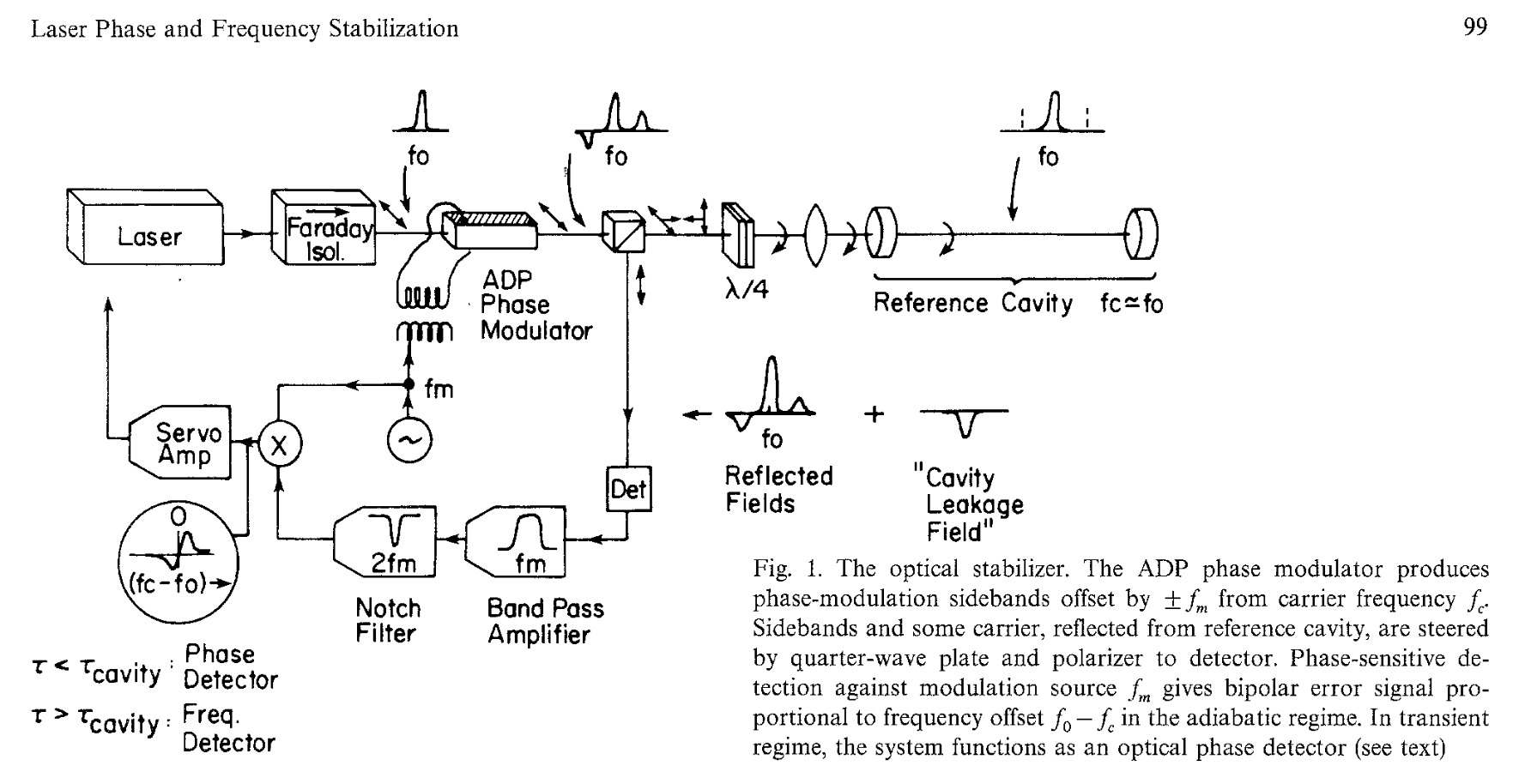
Diagram of the PDH sensing and control setup from 1983.
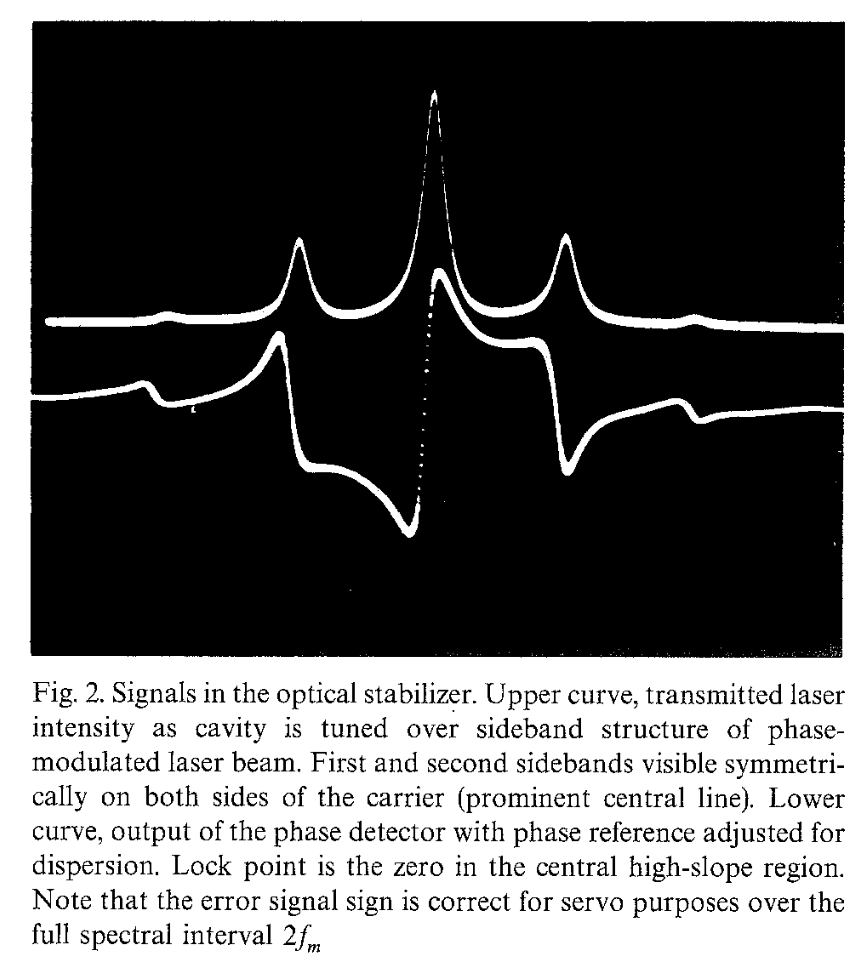
The laser power as a function of cavity phase on top,
the demodulated power PDH error signal on the bottom.
- Drever, R. W. P., Hall, J. L., Kowalski, F. V., Hough, J., Ford, G. M., Munley, A. J., & Ward, H. (1983). Laser phase and frequency stabilization using an optical resonator. Applied Physics B Photophysics and Laser Chemistry, 31(2), 97–105. 10.1007/bf00702605